
Business Website Optimization Guide for Small Businesses

Every small business owner wishes their website could work harder without adding more tech headaches. Knowing how visitors interact with your site is the first step to turning it into a true asset rather than a hassle. By focusing on core website performance metrics, you position your business to attract more customers and give them a smoother experience from the start.
Step 1: Assess Current Website Performance
Measuring your small business website's performance provides critical insights into how visitors interact with your digital presence. Understanding key metrics allows you to make strategic improvements that directly impact customer engagement and conversion rates.
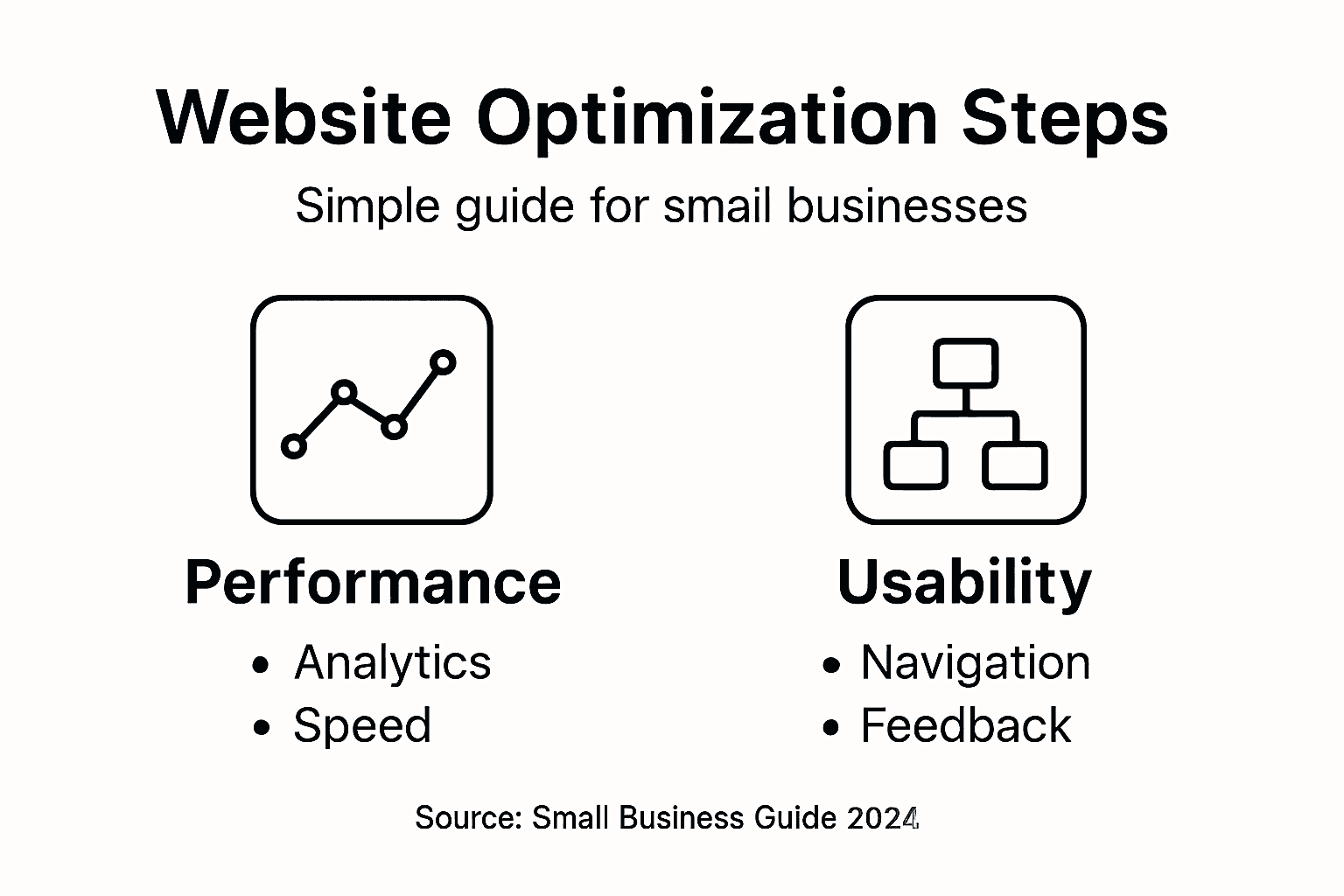
To effectively assess your website's performance, you'll want to analyze several core indicators. Website performance metrics reveal crucial information about user experience and site functionality. Start by examining these fundamental elements:
- Page load speed: Measure how quickly your pages render
- Mobile responsiveness: Check how your site displays on different devices
- User engagement metrics:
- Bounce rate
- Average time on page
- Conversion rates
Utilize web analytics tools to gather comprehensive data about your site's performance. These platforms help you understand visitor behavior patterns and identify potential improvement areas. By systematically tracking web analytics indicators, you can develop targeted strategies to enhance your online presence.

Here's a quick reference on how key website performance indicators influence your business objectives:
| Performance Indicator | Business Impact | Recommended Tool |
|---|---|---|
| Page load speed | Reduces bounce, improves UX | Google PageSpeed Insights |
| Mobile responsiveness | Expands reach, boosts SEO | BrowserStack |
| User engagement | Raises conversions, builds loyalty | Google Analytics |
Consistent monitoring transforms your website from a static digital brochure into a dynamic business asset.
Step 2: Implement Key Design and Usability Fixes
Transforming your small business website from functional to exceptional requires strategic design improvements that enhance user experience and engagement. By implementing targeted usability fixes, you can create a more intuitive and compelling online presence that attracts and retains potential customers.
User interface design guidelines provide a critical framework for improving website usability. Focus on these key areas:
- Navigation clarity: Ensure menu items are logical and easy to understand
- Responsive design: Make your site work seamlessly across all devices
- Visual hierarchy: Organize content to guide user attention
Implement changes systematically by conducting usability testing methods that reveal how real users interact with your site. Pay special attention to user interaction patterns and potential friction points that might discourage visitors from engaging with your content or taking desired actions.
Small design improvements can dramatically increase your website's effectiveness and user satisfaction.
Step 3: Enhance Content and SEO for Visibility
Improving your small business website's search engine visibility requires a strategic approach to content creation and optimization. By implementing targeted SEO techniques, you can increase your online presence and attract more potential customers through organic search results.
SEO principles for content visibility provide a roadmap for enhancing your website's discoverability. Focus on these critical elements:
- Keyword research: Identify terms your target customers actually search for
- Content quality: Create informative, engaging, and original content
- Metadata optimization: Craft compelling titles and descriptions
Implement small business SEO strategies that go beyond basic keyword placement. Pay special attention to local search optimization, ensuring your business appears in location-based searches. This means including your city, region, and service areas naturally within your website content.
Strategic content optimization transforms your website from invisible to irresistible to search engines.
Step 4: Integrate Essential Conversion Tools
Transforming website visitors into actual customers requires strategic implementation of conversion optimization tools. By carefully selecting and integrating the right technologies, small businesses can dramatically improve their ability to capture leads and drive meaningful customer interactions.
Conversion rate optimization tools provide powerful insights into user behavior and engagement. Focus on implementing these critical elements:
- Lead capture forms: Design attractive, simple sign-up mechanisms
- Call-to-action buttons: Create compelling, strategically placed clickable elements
- Analytics tracking: Monitor user interactions and conversion paths
Implement conversion tool strategies that automate and simplify your customer acquisition process. Pay special attention to funnel optimization, ensuring each step of the customer journey is smooth, intuitive, and designed to maximize engagement.
Compare where common conversion tools fit in the customer journey:
| Tool Type | Customer Journey Stage | Primary Benefit |
|---|---|---|
| Lead capture forms | Awareness/Interest | Collects customer information |
| Call-to-action buttons | Consideration/Decision | Nudges visitors to act |
| Analytics tracking | All stages | Identifies optimization opportunities |
The right conversion tools can transform casual browsers into committed customers.
Step 5: Test, Monitor and Refine Results
Successful website optimization is an ongoing process that requires continuous measurement, analysis, and strategic refinement. By systematically tracking your website's performance and making data-driven adjustments, you can ensure your online presence remains effective and competitive.
Business performance monitoring techniques provide a structured approach to evaluating your website's impact. Focus on these critical assessment areas:
- Key performance indicators (KPIs): Track metrics that matter to your business
- Comparative benchmarking: Compare your performance against industry standards
- Regular performance reviews: Schedule monthly or quarterly evaluations
Implement systematic testing strategies that help you identify and address potential improvements. Pay special attention to user experience metrics, such as page load times, navigation ease, and conversion rates.
Continuous improvement transforms good websites into exceptional digital experiences.
Unlock Your Small Business Website's Full Potential Today
Optimizing your small business website can feel overwhelming when faced with challenges like slow page load times, unclear navigation, and the need for impactful content and seamless conversions. These pain points directly affect your visitor engagement, search engine rankings, and ultimately your sales. Vegas Solutions understands these struggles and is here to help you take the guesswork out of website performance and user experience improvements.
Take the stress out of managing your digital presence with our comprehensive services that cover building, hosting, and maintaining your site. You get one point of contact, simple language, and fast turnaround so you can focus on growing your business. Experience how easy website optimization can be by starting with a $69 demo. Visit Vegas Solutions now and start turning your website visitors into loyal customers.