

Your service page is live, but the phone isn't ringing. You've described what you do, listed your services, and even added a contact form. Yet visitors leave without reaching out. This is one of the most common frustrations small business owners face online, and it almost always comes down to how the service page is built. A well-structured service page doesn't just describe your work — it guides a local prospect from curiosity to confidence to action.
Essential Elements Every Service Page Needs
Before writing a single word, it helps to understand what makes a service page actually work. Many business owners treat their service page like a brochure — listing what they offer without addressing why a visitor should care. That gap is where potential clients slip away.
Here's how traditional and modern service page structures compare:
| Element | Traditional Page | Modern Page |
|---|---|---|
| Headline | Generic ("Our Services") | Benefit-driven ("Fast, Reliable Plumbing in Austin") |
| Service description | Vague list of tasks | Specific outcomes and process |
| Trust signals | None or minimal | Reviews, certifications, photos |
| Call to action | Footer contact link | Prominent button on every section |
| Local relevance | Not addressed | City, neighborhood, or region mentioned |
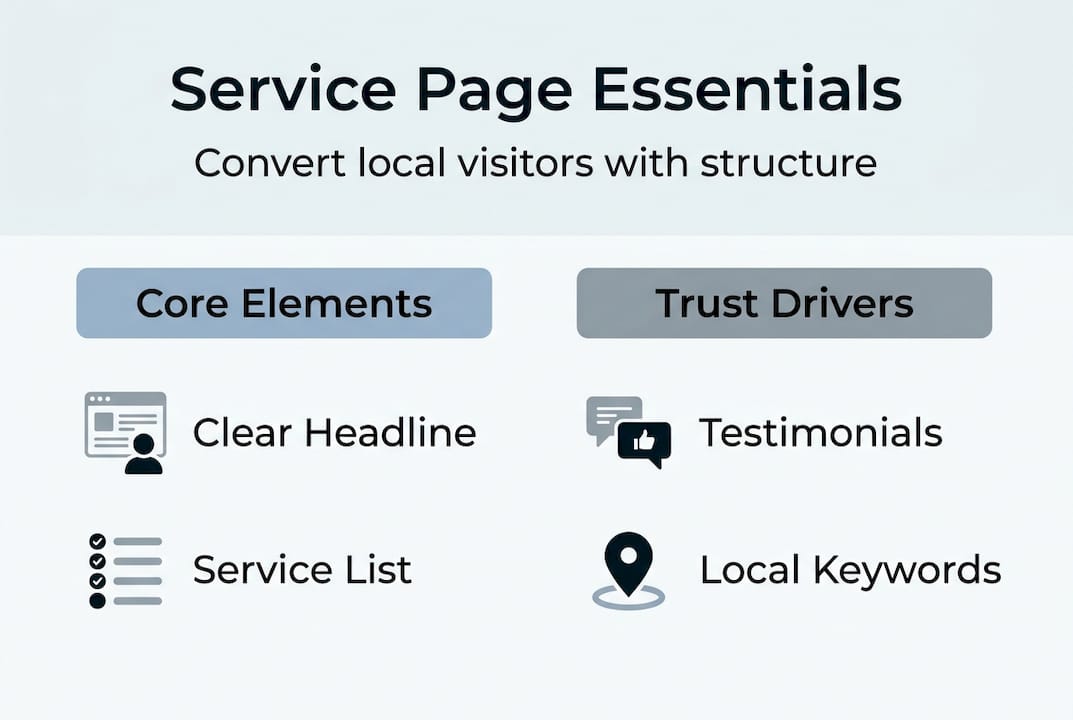
Every strong service page shares a set of core components:
- A clear, benefit-driven headline that tells visitors exactly what you do and who you serve
- A concise value proposition explaining why you're the right choice in your area
- Detailed service descriptions that cover what's included, how it works, and what results to expect
- Trust signals such as client reviews, years of experience, licenses, or before-and-after photos
- A visible call to action (CTA) that tells visitors what to do next — whether that's calling, booking, or requesting a quote
- Contact information that's easy to find without scrolling

Pro Tip: Resist the urge to be clever with your headline. A headline that clearly states "Affordable Roof Repair in Denver" will outperform a vague tagline every time. Clarity converts.
Step-by-Step Process for Planning Your Service Page
Jumping straight into writing without a plan leads to pages that feel scattered and fail to address what local clients actually care about. Follow these steps before you write a single line of copy:
- Define your target audience. Who are the people most likely to hire you? Think about their location, their specific problem, and what they're searching for online.
- Outline your services clearly. Break down each service into what it includes, how long it takes, and what the client gets at the end. Avoid vague descriptions.
- Gather testimonials and proof. Reach out to past clients and ask for a short review. Real quotes from real people in your area carry enormous weight with new visitors.
- Identify local keywords. Think about how people in your city or region search for your service. Phrases like "electrician in Nashville" or "dog grooming near me" signal local intent.
- Map out your page structure. Decide the order of your sections before writing. Most high-performing pages follow: headline → value proposition → service details → social proof → CTA.
| Content Need | Recommended Tool |
|---|---|
| Keyword research | Google Search Console, Ubersuggest |
| Testimonial collection | Google Forms, email follow-up |
| Page structure planning | Simple outline doc or Trello |
| Competitor research | Manual search + Google Maps |
| Image sourcing | Your own photos (preferred), Unsplash |
Pro Tip: After completing a job, send a short follow-up message asking the client to share one sentence about their experience. These quick, authentic responses often become your most persuasive testimonials.
How to Write Persuasive Content That Converts
Writing for a service page isn't the same as writing a blog post or a social media caption. Every sentence needs to serve a purpose: build trust, answer a question, or move the reader closer to contacting you.
The most effective service pages speak directly to local needs. Mentioning your city, referencing local landmarks, or noting how long you've served the community signals to visitors that you understand their world. Generic content feels distant. Specific, local content feels like a conversation.
Writing strategies that consistently improve service page performance:
- Be specific about outcomes. Instead of "we clean homes," write "we deep-clean kitchens and bathrooms in under three hours."
- Use plain, direct language. Avoid industry jargon unless your audience uses it too. Write the way you'd speak to a client in person.
- Address objections early. If price is a common concern, acknowledge it. If your process is unfamiliar, explain it briefly.
- Build trust through transparency. Share your process, your team, and your experience. Clients hire people they feel they know.
- Use geographic references naturally. Mentioning your service area in the body copy — not just the title — reinforces local relevance for both readers and search engines.
A strong call to action is the difference between a visitor who reads your page and one who actually contacts you. Every service page needs at least one clear, specific prompt telling visitors exactly what to do next.
Optimizing Your Service Page for Search Engines and Conversions
Great content won't generate leads if no one can find the page. Local SEO and conversion optimization work together to make your service page both discoverable and effective.
Search engine optimization steps:
- Write a unique title tag for every service page that includes the service name and your city
- Add a meta description (150–160 characters) that summarizes the page and gives people a reason to click
- Use your primary keyword naturally in the H1 heading, the first paragraph, and 2–3 subheadings
- Add alt text to every image describing what the image shows
- Link your service pages to each other and to your contact page
Conversion optimization steps:
- Place your primary CTA button above the fold so it's visible before scrolling
- Add a secondary CTA at the bottom of the page for visitors who read all the way through
- Keep your page load time under 3 seconds — compress images and avoid unnecessary scripts
- Make your phone number a clickable link on mobile
- Test your contact form monthly to confirm it's working and submissions are reaching you
| Optimization area | Goal | Quick check |
|---|---|---|
| Title tag | Include service + city | Edit in your CMS or HTML |
| Meta description | Compelling 150-char summary | Preview in Google Search Console |
| Page speed | Under 3 seconds | Test with Google PageSpeed Insights |
| Mobile CTA | Clickable phone number | Tap it on your phone |
| Contact form | Working and tested | Submit a test inquiry monthly |
What Most Service Pages Miss
After reviewing hundreds of small business service pages, certain patterns appear consistently. The businesses that convert well aren't necessarily the ones with the biggest budgets or the most impressive portfolios — they're the ones that avoid these common gaps:
What most service pages miss:
- A clear answer to "why you and not someone else?" — most pages describe services without differentiating
- Local specificity — pages that could belong to any business in any city feel generic and unconvincing
- Social proof positioned at the right moment — testimonials buried in footers don't convert; place them near your CTA
- Answers to the questions clients ask before hiring — a short FAQ section reduces friction and builds confidence
- Regular updates — pages that haven't been touched in years feel abandoned, even if the business is thriving
What actually makes service pages stand out:
- A brief explanation of your process — step 1, step 2, step 3 — makes the unknown feel manageable
- One strong testimonial placed directly above or below your primary CTA
- A photo of you or your team working — not a stock photo — on every service page
- A specific service area statement ("We serve [City], [Neighborhood], and surrounding areas")
- A FAQ section addressing the 3–5 questions every new client asks
Elevate Your Business With Professionally Managed Service Pages
Most small business owners know their service pages could be stronger. The challenge is finding the time and knowing what to change. A service page that's built with the right structure, written for your specific local audience, and kept current over time becomes one of your most reliable lead-generation tools.
At Vegas Solutions, we build and manage service pages for small businesses that are designed to rank locally and convert consistently. If your current pages aren't bringing in the leads you need, let's talk about what's getting in the way.