

Having a website is a smart starting point, but it won't automatically put your business in front of customers who are searching nearby. Local search optimization is the process that connects your business to people who are ready to buy, call, or visit right now. Without it, even a well-designed website can sit invisible while competitors capture the customers you should be reaching. This guide walks you through the core strategies, practical steps, and expert insights you need to strengthen your local online presence and start attracting more business from your own community.
What Is Local Search Optimization and Why Does It Matter?
Local search optimization (LSO) is the practice of tailoring your online presence so that search engines like Google show your business to customers searching in your area. Think of it as the bridge between someone typing "plumber near me" on their phone and your phone ringing a minute later. It involves your website, your business listings, your reviews, and how consistently your information appears across the web.
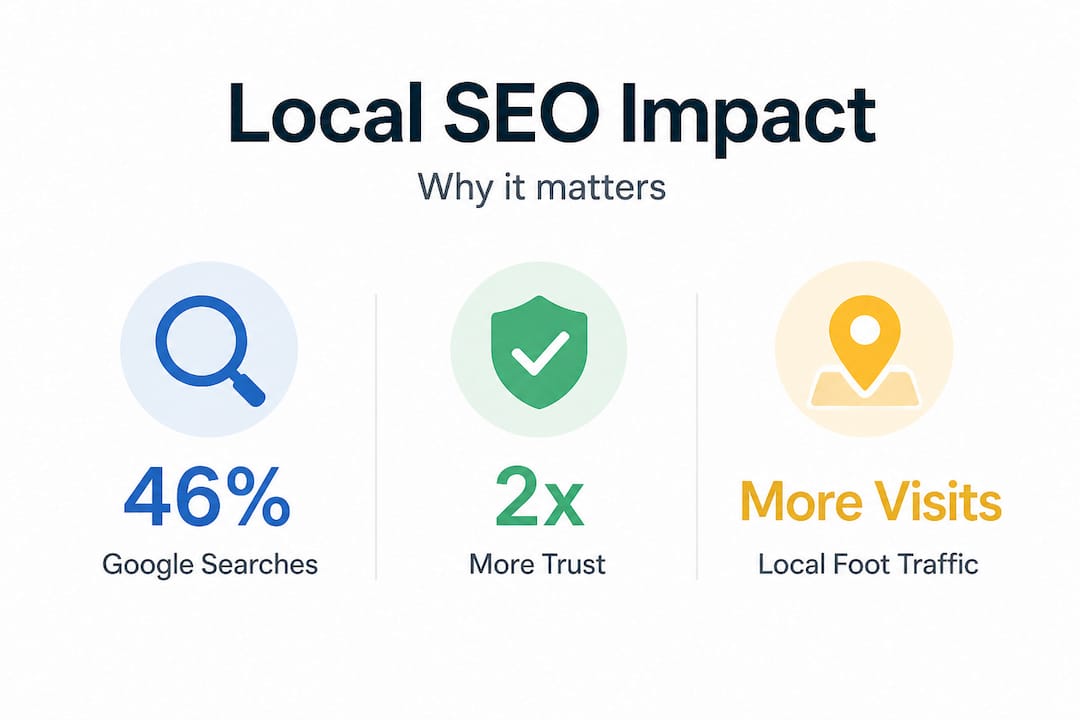
The numbers make a compelling case. 46% of all Google searches have local intent, meaning nearly half of every search is someone looking for something nearby. More striking, 28% of local searches result in a purchase within 24 hours — a conversion window most paid advertising campaigns would envy.
| Impact area | Without local SEO | With local SEO |
|---|---|---|
| Search visibility | Low or absent | High in local results |
| Website traffic | Mostly random | Location-targeted |
| Customer calls | Sporadic | Consistent and qualified |
| Foot traffic | Unpredictable | Driven by search intent |
| Trust signals | Weak | Reinforced by reviews |
For small businesses and self-employed professionals, the benefits of LSO go beyond just visibility. It increases foot traffic, drives direct phone calls, and sends qualified visitors to your website — people who already know what they want and are searching specifically in your area. That makes them far more likely to convert into paying customers than someone who stumbles across a generic ad.
The risks of ignoring LSO are just as real. If your business information is incomplete or inconsistent online, search engines lose confidence in your listing and rank it lower. Competitors who invest even a moderate amount of effort into local optimization will consistently appear above you, capturing customers who never knew your business existed.
Core Elements of Local Search Optimization
Local search optimization isn't a single action. It's a collection of coordinated efforts that, when done consistently, tell search engines exactly who you are, where you operate, and why customers should choose you. Here are the five pillars:
1. Google Business Profile (GBP): Formerly called Google My Business, this free listing is your most powerful local SEO asset. A complete, accurate GBP with photos, hours, services, and regular posts signals to Google that your business is active and trustworthy. Incomplete profiles are a leading reason businesses don't appear in the local "3-pack" — the top three map results on a Google search page.
2. NAP consistency: NAP stands for Name, Address, and Phone number. These three pieces of information must match exactly across your website, GBP, and every directory where your business appears. Even a small variation, like "St." vs. "Street," can confuse search algorithms and hurt your rankings.
3. Local citations and directories: A citation is any online mention of your business details. Getting listed on platforms like Yelp, Bing Places, Apple Maps, and industry-specific directories builds authority and reinforces your location to search engines.
4. Mobile-friendly website design: More than 60% of local searches happen on mobile devices. If your site loads slowly or doesn't display well on a small screen, visitors leave immediately and Google penalizes your ranking. A well-built, responsive website is non-negotiable.
5. Customer reviews: Reviews are both a trust signal for potential customers and a ranking factor for Google. The quantity, quality, and recency of your reviews all influence where your business appears in local results.
| Component | DIY complexity | Impact on rankings | Time to see results |
|---|---|---|---|
| Google Business Profile | Low | Very high | 2 to 4 weeks |
| NAP consistency | Medium | High | 1 to 3 months |
| Local citations | Medium | Moderate to high | 2 to 4 months |
| Mobile-friendly site | High | High | Immediate to 2 months |
| Customer reviews | Low | High | Ongoing |
Pro Tip: Set a recurring monthly reminder to audit your business name, address, and phone number across all platforms. Inconsistencies creep in over time, especially after address changes or rebranding, and they quietly erode your rankings.
Building and Optimizing Your Local Business Website
Your website is the foundation of your local search strategy. Every other optimization effort — from your Google Business Profile to your directory listings — points people back to it. Here is what makes a website genuinely effective for local search:
Location-specific content: Each major service area you cover should have its own page. A roofing company serving three counties needs three location pages, not a single generic "service area" paragraph. Each page should include the city name in the title, heading, and body content, along with locally relevant details that make it feel written for someone in that community, not templated.
LocalBusiness schema markup: This is structured data code added to your website that tells search engines your business name, address, phone, hours, and service area in a standardized format they can read directly. It is one of the fastest technical improvements you can make for local SEO and requires no ongoing maintenance once implemented.
Fast load times: A site that takes more than three seconds to load on mobile loses most of its visitors before they see your content. Core Web Vitals — Google's performance metrics — directly influence local rankings. Compress images, minimize scripts, and use a CDN if your host doesn't provide one.
Clear contact information on every page: Your phone number, service area, and a contact form or booking link should be visible without scrolling on every page. Friction at the contact stage loses customers who were ready to call.
Internal linking between related pages: Link your location pages to your service pages and back. This helps search engines understand the relationship between your content and distributes authority across your site rather than concentrating it on a single page.
An SSL certificate: Every site should run on HTTPS. Browsers warn users about non-secure sites, and Google has confirmed HTTPS as a ranking signal. If your site still shows "not secure" in the browser bar, that is an immediate fix.
Practical Tactics to Boost Your Local Rankings
With the foundation in place, these ongoing tactics produce compounding results over time:
Optimize Your Google Business Profile Consistently
Your GBP is not a set-and-forget asset. Businesses that actively manage their profiles consistently outrank those that don't. Practical steps:
- Upload new photos monthly — Google rewards active profiles and customers prefer businesses with recent, real images
- Post updates, offers, or announcements weekly using the Posts feature
- Answer every question submitted via the Q&A section before competitors or strangers answer them incorrectly
- Keep your hours accurate, especially for holidays, which is one of the most common and damaging profile errors
- Respond to every review, positive and negative, within 48 hours
Build a Review Generation System
Reviews don't happen consistently without a system. The most effective approach is to ask at the moment of highest customer satisfaction — immediately after a job is completed, a service is delivered, or a problem is resolved. Specific tactics:
- Create a short link directly to your Google review page and include it in follow-up texts or emails
- Train anyone on your team who interacts with customers to mention reviews naturally at the end of a positive interaction
- If a customer complains, resolve the issue first, then ask for a review after the resolution — resolved complaints often produce the most enthusiastic reviews
- Never pay for or incentivize reviews; Google's guidelines prohibit this and the risk of profile suspension is not worth it
Build Local Citations Strategically
Not all directories carry equal weight. Prioritize:
- Tier 1: Google Business Profile, Yelp, Bing Places, Apple Maps, Facebook Business
- Tier 2: Industry-specific directories (Houzz for home services, Healthgrades for medical, Avvo for legal, etc.)
- Tier 3: Local chamber of commerce, community directories, and local news sites
Focus on accuracy over volume. Fifty consistent, accurate listings outperform two hundred inconsistent ones.
Create Locally Relevant Content
Content that speaks to your community builds both authority and relevance. Ideas that work:
- Blog posts that answer questions specific to your service area ("How to prepare your roof for Alabama hurricane season" vs. generic "roof maintenance tips")
- Case studies from real local customers (with permission) that show the problem, your solution, and the outcome
- Local resource pages that reference community organizations, events, or landmarks — these earn natural backlinks from local sources
- Seasonal content tied to local events, weather patterns, or community schedules
Content does not need to be lengthy or elaborate. A 400-word post that directly answers a question your customers frequently ask will outperform a 2,000-word generic article that says nothing specific about their situation.
Earn Local Backlinks
Links from other websites in your geographic area carry significant local SEO weight. Natural ways to earn them:
- Sponsor a local event, sports team, or charity — many include a link from their website
- Join your local chamber of commerce, which typically includes a directory listing with a link
- Reach out to local bloggers, news sites, or community publications about a genuinely newsworthy story related to your business
- Partner with complementary businesses to feature each other in blog posts or resource pages
What Most Guides Miss About Sustainable Local Results
Most local SEO advice focuses on tactics. The businesses that see lasting results understand something different: local search optimization is a long-term reputation signal, not a shortcut to a specific ranking.
Google's local algorithm evaluates three core factors:
- Relevance: Does your business match what the searcher is looking for?
- Distance: How close is your business to the searcher's location?
- Prominence: How well-known and trusted is your business online?
Tactics address relevance and distance. Prominence is what separates businesses that dominate local results from those that occasionally appear on page two. Prominence is built through consistent reviews, backlinks, content, and profile activity over months and years.
The practical implication is that local SEO is not a project with a finish line. It is an ongoing investment in your business's digital reputation, compounding in value over time in a way that paid ads cannot replicate once you stop paying.
What that means in practice:
- Block time each month to update your GBP, respond to reviews, and add a piece of local content
- Track your rankings quarterly using Google Search Console or a tool like BrightLocal
- Audit your NAP consistency twice a year and correct any discrepancies that have appeared
- Build one or two local backlinks per quarter through genuine community involvement
Strengthen Your Local Presence with Vegas Solutions
At Vegas Solutions, every website we build is structured for local search from the start — with proper schema markup, location-specific pages, fast mobile performance, and content architecture that helps your business appear in local results for the areas you actually serve.
For small business owners who want to compete in local search without spending hours managing technical details themselves, a professionally built and maintained website is the highest-leverage starting point.
Request a free website demo and see how we build local search visibility into the foundation of every website we create.