

Most small business owners assume SEO is a game reserved for big brands with deep marketing budgets. That assumption is costing them customers every single day. 46% of Google searches carry local intent, and 76% of "near me" mobile searches lead to a real-world action within 24 hours. Local SEO is the strategy that puts your business in front of those searchers at exactly the right moment.
What Is Local SEO and Why Does It Matter?
Local SEO is the practice of improving your business's visibility in location-based search results. When someone types "plumber near me" or "best coffee shop in Austin," Google returns a set of local results — often displayed in a map pack at the top of the page. Local SEO is what gets your business into that map pack.
This is different from traditional SEO, which focuses on ranking for broad, national keywords. Local SEO narrows the target. Instead of competing with every business in the country, you're competing with businesses in your zip code or city. For small businesses, that's a much more winnable game.
The direct benefits are tangible:
- More foot traffic to your physical location
- More phone calls from nearby customers ready to buy
- More website visits from people searching with intent
- Higher trust, since appearing in local results signals credibility
Optimized Google Business Profiles receive 7x more clicks than unoptimized ones. That's not a marginal improvement — it's a multiplier on your visibility with zero additional ad spend.
"Local SEO isn't just about being found. It's about being found by the right people at the right moment, when they're ready to act."
Pro Tip: Claim and verify your Google Business Profile before doing anything else. It's free, it takes less than an hour, and it's the single highest-impact action you can take for local visibility.
How Local SEO Works: The Three Core Ranking Factors
Google uses three core factors to determine which local businesses appear in search results.
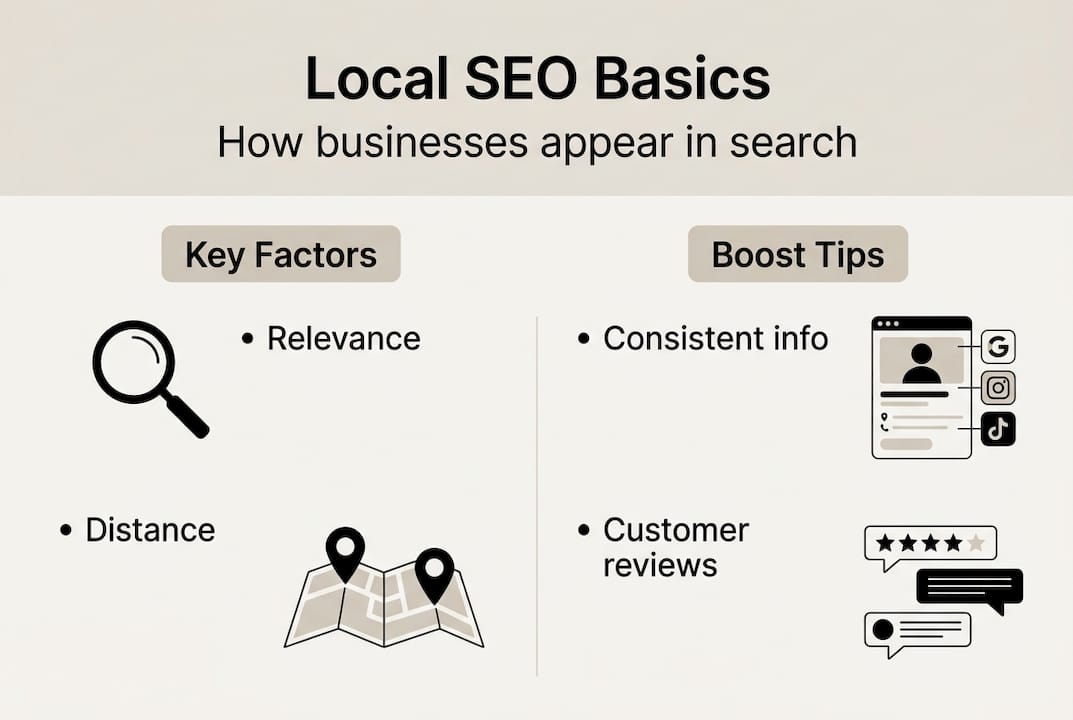
Relevance measures how well your business profile matches what the searcher is looking for. Vague or incomplete profiles hurt relevance scores.
Distance is how close your business is to the searcher. You can't move your business, but you can make sure your address and service area are accurately defined so Google places your pin in the right spot.
Prominence reflects how well-known and trusted your business is. Reviews, backlinks, mentions in local directories, and your overall web presence all feed into prominence.
| Ranking Factor | What It Measures | How to Improve It |
|---|---|---|
| Relevance | Match to search query | Complete profile, accurate categories, keyword-rich description |
| Distance | Proximity to searcher | Accurate address, defined service area |
| Prominence | Reputation and authority | Reviews, citations, backlinks, website quality |

Optimizing Your Online Presence: Profiles, Citations, and Reviews
Step 1: Claim and verify your Google Business Profile. Go to Google Business Profile, search for your business, and follow the verification steps.
Step 2: Complete every section. Add your business name, address, phone number, website, hours, categories, and a detailed description. Upload real photos. Businesses with photos receive significantly more direction requests and website clicks.
Step 3: Build consistent citations. A citation is any online mention of your NAP (Name, Address, Phone number). Consistency is critical. Even a small variation — like "St." versus "Street" or a missing suite number — can confuse Google's systems and drop your map pin to the wrong location.
Key citation platforms to prioritize:
| Platform | Required Fields |
|---|---|
| Google Business Profile | Name, address, phone, website, hours, categories |
| Yelp | Name, address, phone, website, business description |
| Bing Places | Name, address, phone, website |
| Apple Maps | Name, address, phone, website |
| Facebook Business | Name, address, phone, website, hours |
Step 4: Actively collect reviews. Reviews are one of the strongest prominence signals. Ask satisfied customers directly, send a follow-up message after a job is done, or include a review link in your invoice or confirmation email. Quantity, recency, and quality all matter.
Step 5: Optimize your website for local keywords. Include your city name and service area on your homepage, service pages, and contact page. Add your NAP in the footer. Consider a blog that covers local topics or answers questions your customers commonly search for.
Step 6: Post regular updates to your Google Business Profile. Add photos of recent work, announce promotions, share updates. Google rewards active profiles with stronger visibility.
Solving Common Local SEO Pitfalls
| Pitfall | Why It Hurts | Fix |
|---|---|---|
| Unverified or unclaimed profile | Competitor can suggest edits; lower trust signals | Claim and verify immediately |
| Inconsistent NAP across directories | Geocoding failures, lower prominence | Audit and correct all citations |
| No reviews or inactive review requests | Low prominence score | Build a simple review request system |
| Wrong or missing business categories | Reduces relevance to key searches | Use the most specific category available |
| No photos on profile | Fewer clicks and direction requests | Upload at least 10 real photos |
| Keyword stuffing in profile name | Violates Google guidelines, risk of suspension | Use your real business name only |
| No response to reviews | Signals inactivity | Respond to all reviews, positive and negative |
Service-area businesses face an additional challenge: without a storefront, visibility in a defined radius depends on a clearly set service area, strong review velocity, and a well-optimized website. The more Google trusts your data, the better your coverage.
Pro Tip: Search your own business on Google Maps from an incognito window. What you see is what a new customer sees. If your pin is in the wrong place, your hours are wrong, or your photos are missing, fix those issues first.
Local SEO Is a Business Growth Lever, Not a Checkbox
Most small businesses treat local SEO as a one-time task: claim the profile, fill it in, forget about it. That approach gets you the minimum. The businesses consistently at the top of local results treat it as ongoing maintenance.
They respond to every review. They add new photos regularly. They update their profile when hours or services change. They build citations one by one over time. They optimize their website pages for local keywords. None of these tasks are complicated individually — but the combination, done consistently, compounds into a significant competitive advantage.
The businesses at the top of your local map pack aren't there because they're bigger or better funded. They're there because someone has been maintaining their local SEO while their competitors haven't.
Take Your Local Visibility to the Next Level
At Vegas Solutions, every website we build includes local SEO foundations: proper NAP in the footer, location-relevant page copy, and schema markup that helps Google understand your business. If you're starting from scratch or trying to improve an existing presence, let's talk about what a focused local SEO strategy could do for your visibility.