
SEO Basics for Small Businesses: Boost Your Local Reach

Discovering why your business is buried on Google when your competitors show up instead can be frustrating. For many American small business owners, standing out online feels like a constant challenge, especially against bigger chains with large advertising budgets. Understanding Search Engine Optimization gives you the power to appear when local customers look for what you offer, using straightforward steps that do not require advanced tech skills.
What SEO Means for Small Businesses
SEO stands for Search Engine Optimization. It means improving your website so that Google and other search engines rank it higher when people search for what you offer. When a potential customer searches "plumber near me" or "pizza delivery downtown," SEO is what determines whether your business shows up on the first page or gets buried on page five.
Think of search engines as a massive directory of local customers actively looking for your services right now. Search Engine Optimization improves website visibility by making your site more appealing to Google's ranking system. This matters because search traffic converts better than traditional advertising. A customer who searches for your specific service is already interested in buying. They are not seeing an ad they did not ask for. They are hunting for a solution you provide.
For small businesses, SEO is about competing fairly. Without it, larger companies with bigger marketing budgets push you down the rankings. With it, you can rank higher than competitors who have not invested in optimization. Your bakery on Main Street can appear above a chain store three towns over when someone searches "fresh bread local business."
The core components are straightforward. Keyword research identifies what customers actually type into search bars. Technical optimization ensures your website loads fast and works smoothly on phones. Quality content answers the questions your customers are asking. Local SEO helps you dominate searches in your geographic area. Each piece works together to tell Google that your site deserves to rank higher.
The payoff is genuine. More visibility means more website visitors. More visitors means more phone calls, walk-ins, and sales. Unlike paid ads that stop working the moment you stop paying, SEO builds momentum over time. A well-optimized website keeps attracting customers months and years after you launch it.
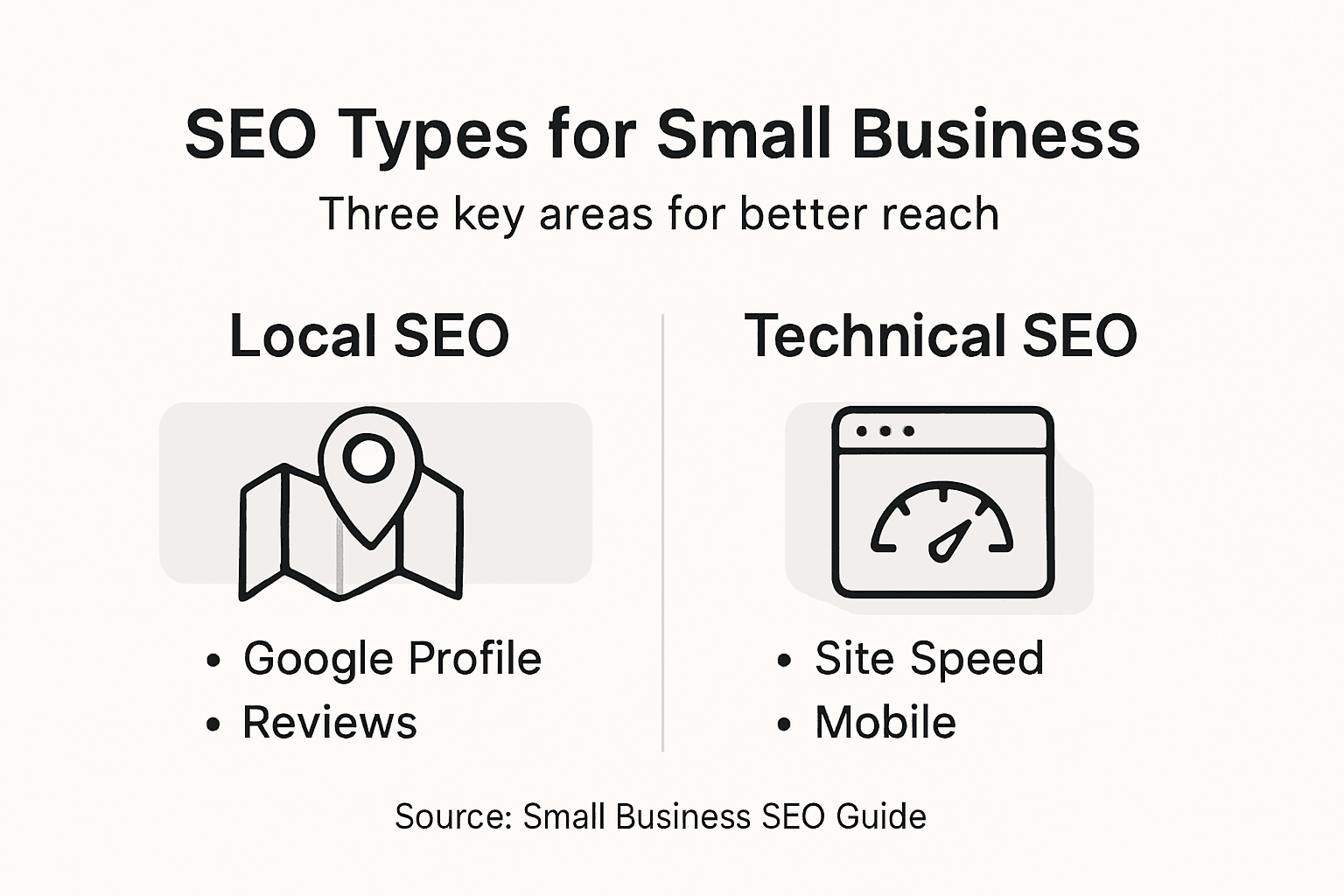
Key SEO Types: Local, On-Page, Technical
SEO is not one single thing. There are different types working together to boost your visibility. Understanding each one helps you know where to focus your efforts and why certain changes matter for your business.
Local SEO
Local SEO targets customers searching in your geographic area. When someone types "coffee shop near me" or "dentist in Austin," local SEO is what determines if your business appears. This type is critical for small businesses because most of your customers live within a few miles of your location.
Local SEO involves claiming your Google Business Profile, getting listed in local directories, and collecting customer reviews. It also means optimizing your website with your address, phone number, and local keywords. When you do this right, you show up in Google Maps results and local search listings.
On-Page SEO
On-page SEO focuses on optimizing content elements like titles, headings, and descriptions that visitors see. It is about making your web pages speak Google's language while remaining helpful to actual people reading them.
This includes putting relevant keywords in your page titles and headers, writing clear meta descriptions that appear in search results, and organizing your content so it is easy to scan. When your pages are well-structured, both Google and visitors find what they need faster.
Technical SEO
Technical SEO happens behind the scenes. It ensures Google can crawl your website easily, your pages load quickly, and everything works smoothly on mobile phones. A slow website that does not work on smartphones will rank lower, no matter how good your content is.

This covers site speed, mobile-friendliness, proper site structure, and clean code. You do not need to understand the code yourself, but you should know that these factors matter. A well-built website gives you a foundation for all other SEO efforts to work properly.
How They Work Together
Each type serves a specific purpose, but they build on each other. Technical SEO creates a solid foundation. On-page SEO makes your content discoverable. Local SEO connects you with nearby customers. Skip any one of them, and your ranking potential suffers.
How SEO Improves Web Visibility
Visibility online starts with being found. Without SEO, your website sits in the digital equivalent of a back alley where nobody walks. SEO changes that by making sure potential customers see your business when they search for what you offer.
When someone searches for your product or service, Google returns thousands of results. Most people click on one of the first five results they see. If your website is buried on page three or four, those customers never find you. SEO increases organic traffic by ranking higher in search results, putting your business directly in front of people actively looking to buy.
This matters because search engine traffic converts better than most other sources. A person who searches "pizza delivery near me" is hungry and ready to order. They are not casually browsing. They want to spend money today. Compare that to someone who sees a random ad on social media. The searcher has already made up their mind to take action. They just need to find you.
Improved visibility also builds trust. When your business appears in the first few search results, customers assume you are legitimate and established. Ranking high signals that Google trusts your site. This psychological boost translates to more clicks and more business.
Beyond rankings, SEO improves how your website works for visitors. Better navigation, faster loading speeds, and clear content structure make the user experience smoother. Optimizing keywords, website structure, and content quality ensures visitors find what they need quickly. People stay longer on your site, explore more pages, and are more likely to contact you or make a purchase.
The compounding effect is powerful. More visibility brings more traffic. More traffic gives you more chances to convert customers. More customers mean more revenue. Unlike paid advertising that stops working when you stop paying, this momentum builds over time.
Essential Steps: Keyword Research and Setup
Keyword research is where SEO begins. Before you write a single word on your website, you need to know what your customers are actually searching for. This foundation determines everything else you do.
Understanding Your Keywords
Keyword research identifies words and phrases users enter into search engines to find information. It is the process of discovering what real people type when looking for your services. A plumber should know if customers search "emergency plumber" or "24-hour plumbing." A contractor needs to understand whether people search "kitchen remodel" or "kitchen renovation."
The right keywords match what your business offers with what customers actually want. This alignment is what makes SEO work. Without it, you optimize for terms nobody searches or terms that do not match your business.
Two Keyword Types to Know
Keywords fall into two categories. Short-tail keywords are broad and competitive, like "pizza" or "plumber." Long-tail keywords are more specific, like "best pizza delivery downtown" or "emergency plumber open now."
Long-tail keywords typically have less competition and higher conversion rates. A person searching for "emergency plumber open now" is more likely to hire you than someone searching just "plumber." Start with long-tail keywords because they are easier to rank for and attract customers closer to making a purchase decision.
How to Research Keywords
Start by thinking like your customer. What problems do they have? What phrases would they use to find a solution? Write down 10 to 15 ideas. Then use free tools like Google Search Console or Google Trends to see actual search volume and competition levels.
Analyze your competitors. Search your main keywords and see which local businesses rank. Visit their websites and notice which keywords they target. This research takes a few hours but saves months of guessing wrong.
Setting Up Your Keywords
Once you have your list, organize them by page. Your homepage targets your main keywords. Service pages target related long-tail variations. Blog posts target informational keywords customers search when learning about problems you solve.
This mapping prevents wasted effort and ensures every page has a clear purpose. Your website becomes a coordinated system instead of random pages hoping to rank.
Common Pitfalls and How to Avoid Them
SEO mistakes are easy to make, especially when you are doing it yourself for the first time. Understanding these pitfalls helps you avoid wasting months of effort on strategies that do not work.
The Patience Problem
The biggest mistake small business owners make is expecting immediate results. SEO takes time. Real ranking improvements typically show up after three to six months of consistent work. If you abandon your strategy after two months because you see no results, you miss the payoff entirely.
Set realistic expectations from the start. Plan for a six-month timeline before evaluating whether your strategy is working. This mindset keeps you from making desperate decisions that can actually hurt your rankings.
Chasing Vanity Metrics
Traffic numbers look impressive, but they tell only part of the story. Focusing on metrics that do not drive business value wastes your effort. You might get 1,000 website visitors per month, but if none of them call you or fill out a contact form, that traffic means nothing.
Track the metrics that matter. Measure phone calls, form submissions, appointment bookings, and actual sales. These numbers show whether SEO is bringing you customers who will pay you money.
Relying on One Tool
Many small business owners use only Google Analytics or only Google Search Console. This incomplete picture leads to bad decisions. Use multiple tools to understand user behavior and get a full view of your SEO performance.
Combine free tools like Google Analytics, Google Search Console, and Google Business Profile insights. This combination reveals what keywords bring visitors, how visitors behave on your site, and where your local searches come from.
The Black Hat Temptation
Some companies promise quick ranking improvements using shortcuts. These techniques violate Google rules and can get your website permanently banned from search results. Avoid them completely. No quick win is worth losing your online visibility.
Stick to legitimate SEO strategies focused on user experience and quality content. These work slower but deliver lasting results.
Ignoring Algorithm Updates
Google changes how it ranks websites several times per year. If you set your SEO strategy and never revisit it, you fall behind as the rules change. Staying updated with search engine algorithm changes keeps your strategy effective over time.
Review your strategy quarterly. Check Google's blog for major updates. Adjust your approach as needed. This ongoing attention keeps your rankings stable.
Take Control of Your Local SEO Without the Tech Headaches
If you are a small business owner ready to improve your local search ranking but feel overwhelmed by technical SEO, keyword research, or website maintenance, you are not alone. This article highlights how crucial it is to have a strong local and technical SEO foundation to attract nearby customers and turn searchers into paying clients. The challenge is clear. You want your website to load fast, rank higher, and reflect the valuable service you provide, yet managing this on your own can be confusing and time-consuming.
Let Vegas Solutions carry the burden for you. We specialize in helping small businesses and self-employed professionals by building, hosting, and maintaining your website using simple language and one clear point of contact. Whether you are focusing on local SEO efforts or need onsite SEO optimized content, we ensure your website runs smoothly and ranks where it matters.
Get Started Today and see how effortless SEO success can be.
Stop struggling to manage your website alone and start focusing on growing your business. Start with a $69 demo and only continue if it feels like the perfect fit. Your local customers are searching. Make sure they find you with Vegas Solutions.