

Most small business websites look professional but quietly fail at their main job: generating leads. A polished design can make a strong first impression, but it rarely closes the gap between a visitor and a paying customer. 70% of small business websites lack clear calls to action, which means the majority of site visitors leave without ever taking the next step.
In 2026, the difference between a website that earns business and one that just exists comes down to strategy, structure, and follow-through.
Understanding the Website's Role in Modern Lead Generation
Lead generation is the process of attracting people who are interested in what you offer and getting their contact information so you can follow up. For small businesses, a website is the most reliable hub for this process. It works around the clock, reaches people who are actively searching for your services, and creates a first impression that traditional marketing cannot match.
Unlike a billboard or a cold call, a well-structured website meets potential customers where they already are. Someone searching for a plumber, a tax preparer, or a personal trainer in their area is already motivated. Your website's job is to capture that intent before they move on to a competitor.
The core elements that make a website effective for lead generation:
- Landing pages designed around a single offer or service, with minimal distractions
- Lead capture forms that make it easy for visitors to request a quote or schedule a call
- Lead magnets like free guides or consultations that give visitors a reason to share their contact information
- Clear navigation that guides users toward a conversion action without confusion
SEO leads close at 14.6% compared to just 1.7% for outbound methods like cold calling or direct mail. That's a dramatic difference, and it reflects the power of inbound intent.
A website built around lead generation is not just a digital brochure. It is a system that qualifies, captures, and moves prospects toward a decision.
Critical Features: What Your Lead-Generating Website Must Have
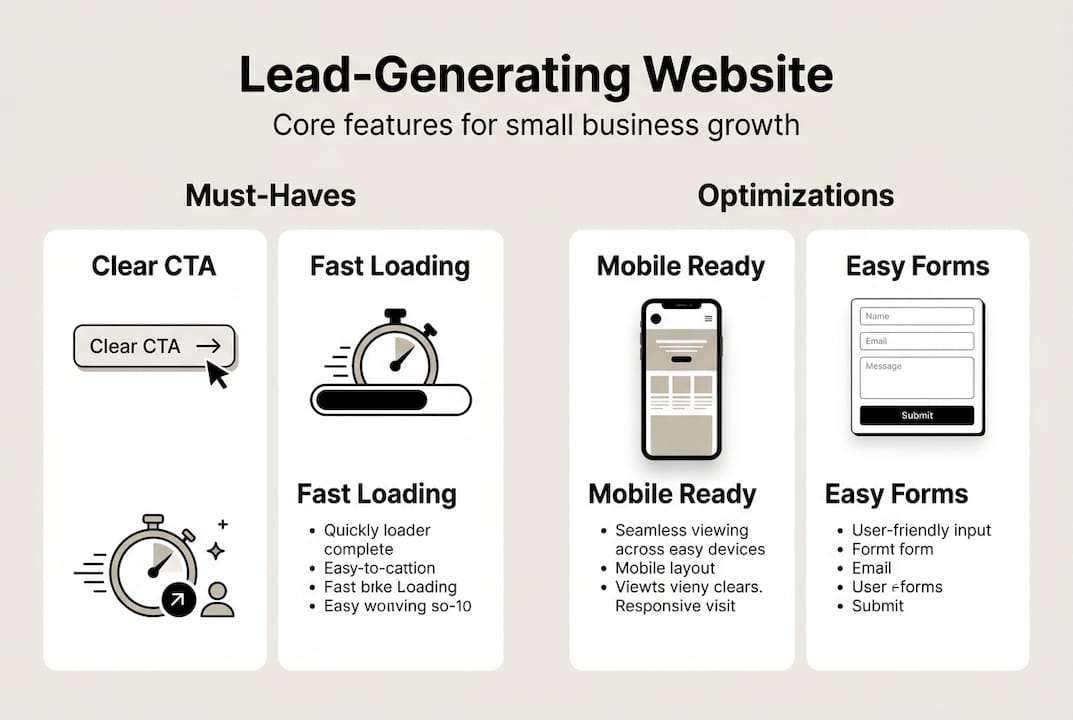
The most common reason small business websites underperform is not poor design. It's missing or weak conversion elements. 70% of small business sites lack a clear CTA, and multi-step forms convert 205% better than single-step forms.
What every lead-generating website needs:
- Strong calls to action (CTAs): Every page should tell visitors exactly what to do next. "Get a free quote," "Book a call," or "Request a demo" are clear and action-oriented.
- Mobile responsiveness: Nearly 59% of all web traffic comes from mobile devices. A site that breaks on a phone loses leads instantly.
- Fast load times: Slow pages increase bounce rates. A 1-second delay can reduce conversions by up to 7%.
- Trust signals: Testimonials, reviews, certifications, and before-and-after examples all reduce hesitation.
- Simple, focused forms: Ask for only what you need. Name, email, and phone number is usually enough to start a conversation.
| Feature | With It | Without It |
|---|---|---|
| Clear CTA | Higher conversion rate | Visitors leave without acting |
| Mobile optimization | Reaches 59% of traffic | Loses majority of visitors |
| Multi-step forms | Up to 205% better conversions | Lower form completion rates |
| Trust signals | Builds credibility fast | Visitors hesitate or leave |
| Fast load time | Keeps users engaged | High bounce rate |
Pro Tip: Walk through your own website as if you're a first-time visitor. Is it immediately clear what you do, who you serve, and what to do next? If you have to think about it, your visitors will leave.
The Power of Local SEO and Content for Attracting Quality Leads

Once core features are in place, it's about driving the right traffic. Local search optimization is one of the highest-return activities for small businesses.
| Traffic Source | Close Rate | Cost Over Time |
|---|---|---|
| SEO (inbound) | 14.6% | Decreases as content builds |
| Outbound (cold calls, ads) | 1.7% | Ongoing and often high |
A simple local SEO plan to get started:
- Claim and complete your Google Business Profile. Add your hours, photos, services, and a link to your website.
- Create location-specific pages. If you serve multiple cities or neighborhoods, give each a dedicated page targeting that area.
- Publish answers to real questions. Blog posts that answer "how much does X cost in [city]" or "what to look for when hiring [service]" attract searchers with buying intent.
- Build local citations. Consistent Name, Address, and Phone number across Yelp, Apple Maps, Bing Places, and Facebook strengthens your local signals.
- Ask for reviews regularly. Fresh reviews on Google improve both your prominence ranking and your credibility with visitors.
Optimizing for Conversions: From Visitors to Leads
Getting traffic is only half the equation. Converting that traffic into leads is where most small businesses leave money on the table.
Practical conversion optimization steps:
- Add a CTA above the fold. Visitors shouldn't have to scroll to find out how to contact you.
- Use multi-step forms. Starting with one easy question ("What service do you need?") before asking for contact details increases completion rates dramatically.
- Add real photos. A photo of you, your team, or your completed work builds trust faster than stock photography.
- Display social proof prominently. A single specific testimonial near your CTA can meaningfully improve conversion rates.
- Make phone numbers clickable. On mobile, a tappable phone number removes friction and captures leads who prefer to call.
- Test your forms monthly. Submit your own form. Make sure you receive it. Make sure the confirmation email sends.
Pro Tip: Replace "Submit" on your form button with something specific: "Get My Free Quote" or "Book My Free Call." Specific button text consistently outperforms generic text.
Integrating Your Website with Follow-Up Systems
Generating a lead is only the beginning. What happens next determines whether that lead becomes a customer.
| Integration | What It Does | Why It Matters |
|---|---|---|
| CRM (HubSpot, etc.) | Captures and organizes lead data | Prevents leads from falling through the cracks |
| Email automation | Sends confirmation and nurture sequences | Keeps your business top-of-mind |
| Scheduling tool (Calendly) | Lets leads book directly | Eliminates phone-tag friction |
| SMS follow-up | Reaches leads immediately after form submission | Dramatically increases contact rates |
| Call tracking | Shows which pages generate phone calls | Helps you double down on what works |
The businesses that convert the most leads respond fastest. Responding within 5 minutes of a form submission increases your chances of making contact by 100x compared to waiting 30 minutes. Even an automated confirmation email that arrives immediately buys goodwill and sets expectations while you prepare a personal follow-up.
Why True Lead Generation Is More Than Just Good Looks
Most small business owners judge their websites by how they look. The businesses generating consistent leads judge their websites by how they perform. Those are very different measurements.
A website that converts well might not win a design award. But it has a visible CTA above the fold. It loads in under 3 seconds. It works perfectly on a phone. It has real testimonials from real customers. It has a form that submits reliably and triggers a follow-up within minutes.
Those are the elements that produce revenue, not the color palette or the font choice.
A quick self-audit for your current website:
- Is there a clear CTA visible on the homepage without scrolling?
- Does the site load in under 3 seconds on mobile?
- Does every service page explain what visitors get, not just what you offer?
- Are there real testimonials with names and specific outcomes?
- Does your contact form actually work and trigger a follow-up?
If any of those answers are no, you have a lead generation problem — not a traffic problem.
How Vegas Solutions Can Help You Capture More Leads
At Vegas Solutions, every website we build is structured for lead generation from the first page to the last. Clear CTAs, mobile-first design, fast load times, and trust signals aren't add-ons — they're built in. If your current site isn't generating consistent inquiries, let's talk about what a focused rebuild could do for your business.