

Managing a website can feel like an ongoing distraction when you would rather focus on serving customers and growing your business. For many small business owners, tech headaches and security worries slow down progress and drain valuable time. With a managed website, you hand off technical duties to a dedicated provider, letting you enjoy a seamless and secure online presence without learning complex skills or hiring expensive IT support.
Table of Contents
- What Are Managed Websites And How They Work
- Key Features Of Fully Managed Sites
- Common Challenges Solved By Managed Packages
- Cost, Risks, And Comparing Alternatives
- Who Benefits Most From A Managed Website
Key Takeaways
| Point | Details |
|---|---|
| Managed Websites Simplify Maintenance | Your hosting provider handles all technical aspects, allowing you to focus solely on your business operations. |
| Enhanced Security and Support | 24/7 monitoring and automatic updates protect your website from security threats and performance issues. |
| Cost-Effective Solution | Managed websites save money by eliminating the need for full-time IT staff and reducing the risks of downtime and security breaches. |
| Ideal for Busy Professionals | Service-based professionals and small business owners benefit from a streamlined online presence without the technical burden. |
What Are Managed Websites and How They Work
A managed website is a fully handled solution where your hosting provider takes care of everything behind the scenes. You focus on your business; they handle the technical details. Think of it like hiring a property manager instead of being one yourself.
Here's what your hosting provider actually manages for you:
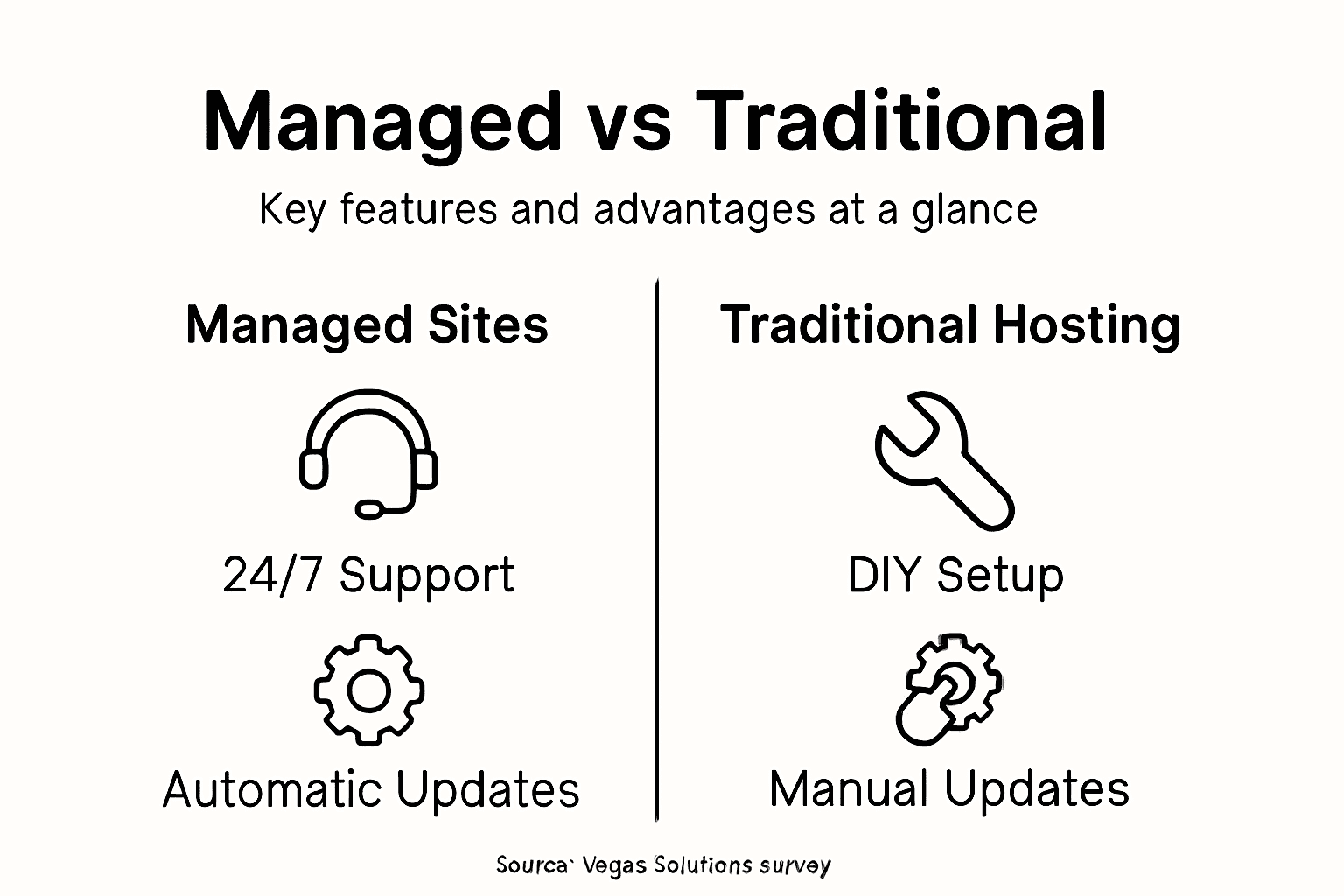
- Server maintenance and updates — They handle security patches, software updates, and system upgrades so vulnerabilities don't put your business at risk
- Automatic backups — Your website data is backed up regularly, protecting you from data loss
- Performance monitoring — They watch your site's speed and stability 24/7, fixing issues before they affect your customers
- Security management — SSL certificates, firewalls, and security protocols run without your involvement
- Technical support — You have a real person to contact when something needs to change
How the System Actually Works
When you publish a blog post or update a service page, you're using a simple content management system. No coding required. You write, format, and click publish. Behind the scenes, the hosting provider ensures that content stays secure, loads quickly, and remains accessible to your visitors.
The hosting provider also monitors your website's health constantly. If performance dips or a security threat appears, they respond immediately — you don't even know there was a problem. This is fundamentally different from traditional hosting, where you or a developer must handle every technical task. To see how managed services stack up against self-managed platforms, read our honest comparison of the best website hosting platforms for small business.
Managed websites eliminate the gap between running your business and maintaining your online presence — one less thing to worry about.

Pro tip: When choosing a managed website provider, ask what's included in their support — fast response times and clear communication matter more than technical jargon.
Key Features of Fully Managed Sites
Fully managed websites come equipped with features designed to keep your business online and running smoothly without your constant attention. These aren't generic templates — they're built for reliability and growth.
The core strength of managed sites is 24/7 monitoring and support. Your website is watched around the clock, detecting problems before they impact your customers. If something goes wrong at 2 a.m., your provider is already working on it.
Here are the essential features you get:
- Automatic backups and disaster recovery — Your data is backed up continuously, so data loss becomes nearly impossible
- Security management — Firewalls, malware removal, and round-the-clock monitoring protect your site from threats
- Proactive maintenance — Security patches and software updates happen automatically without your involvement
- Performance optimization — Real-time monitoring ensures your site loads fast and stays responsive. This matters because fast website speed directly impacts your sales and search rankings
- Expert support team — Real people handle both routine maintenance and unexpected problems
What Makes These Features Different
With traditional hosting, you wait for problems to happen, then pay someone to fix them. Managed websites stop problems before they start. Your provider watches your site's health metrics constantly — uptime, speed, security vulnerabilities — and takes action before customers notice anything wrong.
Content management becomes simple too. Update your pages, publish blog posts, and add images using a straightforward interface. No coding knowledge required. Scalability is built in as well — as your business grows and your website gets more traffic, managed sites automatically adjust resources to maintain performance. The key benefits of quality website hosting all apply here, delivered as part of one managed package.
Fully managed sites turn website maintenance from a constant worry into a handled responsibility — you pay one provider and they handle everything.
Pro tip: Ask your managed website provider for a detailed list of what's monitored and how quickly they respond to alerts — response time directly impacts how fast problems get solved.
Common Challenges Solved By Managed Packages
Small business owners face a consistent problem: managing a website while running a business is exhausting. Managed packages directly address the real challenges you encounter every day.
The first major challenge is security threats. Hackers target small businesses constantly because they often lack robust defenses. Managed packages handle cybersecurity threats and patch management automatically, keeping vulnerabilities patched before attackers can exploit them.
Here's what managed packages solve:
- Data loss and disaster recovery — Your business data is protected with automated backups, so a server crash doesn't mean losing years of customer information
- Security vulnerabilities — Firewalls and monitoring catch threats before they damage your reputation or customer trust
- Downtime and lost revenue — 24/7 monitoring means your site stays up, keeping customers happy and sales flowing
- Complex infrastructure management — You don't need to understand server configurations or technical complexity
- Hidden costs and surprise expenses — Transparent billing with managed packages means no unexpected bills for emergency repairs
Real Problems Small Businesses Face
Many business owners work with fragmented systems that don't communicate properly. Email hosted one place, website elsewhere, customer data scattered — this creates security gaps and wasted time. Managed packages solve this by integrating everything seamlessly.
Another common problem is overlooked maintenance. You plan to update your website next month, but urgent business issues come up. Months pass. Your site becomes outdated and vulnerable. Managed services handle this automatically.
Managed packages transform website management from a source of stress into a predictable, handled responsibility.
The time savings alone justify the investment. Instead of learning technical skills or hiring IT staff, you focus on what you do best — growing your business.
Pro tip: When evaluating managed packages, ask specifically about their response time to security alerts and uptime guarantees — these directly protect your revenue and reputation.
Cost, Risks, and Comparing Alternatives
Managed websites come with a monthly cost, but understanding what you're actually paying for matters more than the price tag itself. The real question isn't whether managed websites cost money — it's whether the alternatives cost you more.
A managed website typically costs between $50 and $300 per month depending on features and support level. That sounds like an expense until you calculate what you'd spend on alternatives:
- Hiring a developer or IT person — $50,000 to $100,000+ annually for even part-time technical staff
- DIY learning curve — Hours of your time studying website management (valued at your hourly rate)
- Security breaches and recovery — Thousands of dollars to fix a hacked website and restore customer trust
- Unplanned downtime — Every hour your site is down costs lost sales and damaged reputation
- Piecemeal solutions — Hosting here, email there, backups elsewhere — managing multiple vendors and bills
The Hidden Risks of Going It Alone
Managing your own website creates real risks that managed packages eliminate. Security becomes your responsibility. One missed patch and hackers exploit your site. One forgotten backup and you lose customer data. Downtime is another risk — if your site goes down on a Saturday night, who fixes it? You'll be scrambling, potentially losing business while you troubleshoot.
The real cost of a website isn't what you pay monthly — it's what you lose when something goes wrong.
Comparing Your Options
You have three basic paths: do it yourself, hire a developer, or use managed services. Do-it-yourself saves upfront costs but demands your time and exposes you to security risks. Hiring a developer gives you expertise but costs thousands monthly. Managed services provide the middle ground — professional expertise, 24/7 support, and peace of mind without the overhead of hiring staff.
| Approach | Upfront Time Investment | Risk Level | Long-Term Cost |
|---|---|---|---|
| DIY | High; learning required | High; no backup support | Low at first, can rise sharply |
| Hire Developer | Minimal; delegate work | Moderate; depends on individual | Very high; salary/retainer |
| Managed Service | Low; provider handles setup | Low; 24/7 protection | Predictable; monthly fee |
Pro tip: Calculate your hourly rate, then multiply it by the hours you'd spend managing website issues monthly — you'll quickly see that managed packages pay for themselves.
Who Benefits Most From a Managed Website
Managed websites aren't one-size-fits-all solutions, but certain business types gain the most value. Small business owners without technical skills benefit immediately — you didn't start your business to become a web developer.
These groups see the biggest impact:
- Service-based professionals — Consultants, contractors, accountants, and coaches need credibility fast without technical overhead
- Solopreneurs and freelancers — You wear every hat already; managed websites remove one major responsibility
- Local service providers — Plumbers, electricians, cleaners, and similar businesses need reliable websites customers trust
- Early-stage companies — Startups benefit from professional hosting without hiring IT staff
- Busy business owners — Anyone whose time is better spent on revenue-generating activities
Why These Groups Win With Managed Services
Service providers and contractors especially benefit. Your reputation depends on appearing professional and trustworthy. A well-built, managed website with all the essential elements of a professional website positions you ahead of competitors still using outdated sites.
Solopreneurs gain back hours weekly. Instead of troubleshooting technical issues, you sell services and grow your business. Local service providers see faster customer acquisition — a managed website ranks better in local searches, loads faster on mobile, and converts visitors to clients more effectively. This is especially true when your site is paired with a solid SEO strategy for service businesses.
Managed websites give busy professionals the competitive advantage of a large company's online presence without the large company's overhead.
Business owners with limited budgets also win. You avoid hiring developers or IT staff. Managed websites cost far less than full-time technical employees, and you get consistent, professional results with predictable monthly billing.
| Benefit Area | Managed Website Advantage | Real-World Impact |
|---|---|---|
| Security | Automated updates, monitoring | Fewer breaches, less downtime |
| Productivity | No coding or technical tasks | More time for revenue work |
| Cost Control | Single predictable bill | Easier budget planning |
| Scalability | Handles traffic surges | No lost sales during growth |
Pro tip: If you've been avoiding website updates because they feel too technical or time-consuming, you're exactly the person who benefits most from managed services.