

You've invested time and money into your website, yet it barely shows up in search results. That's a frustrating reality for many small business owners and self-employed professionals. Search engine optimization (SEO) — the practice of making your website more visible in search engines like Google — is the bridge between having a site and getting found by the right people. The good news is that core SEO mechanics are accessible to business owners at any level. This guide walks through each step clearly so you can start making real improvements today.
Prepare your website for SEO success
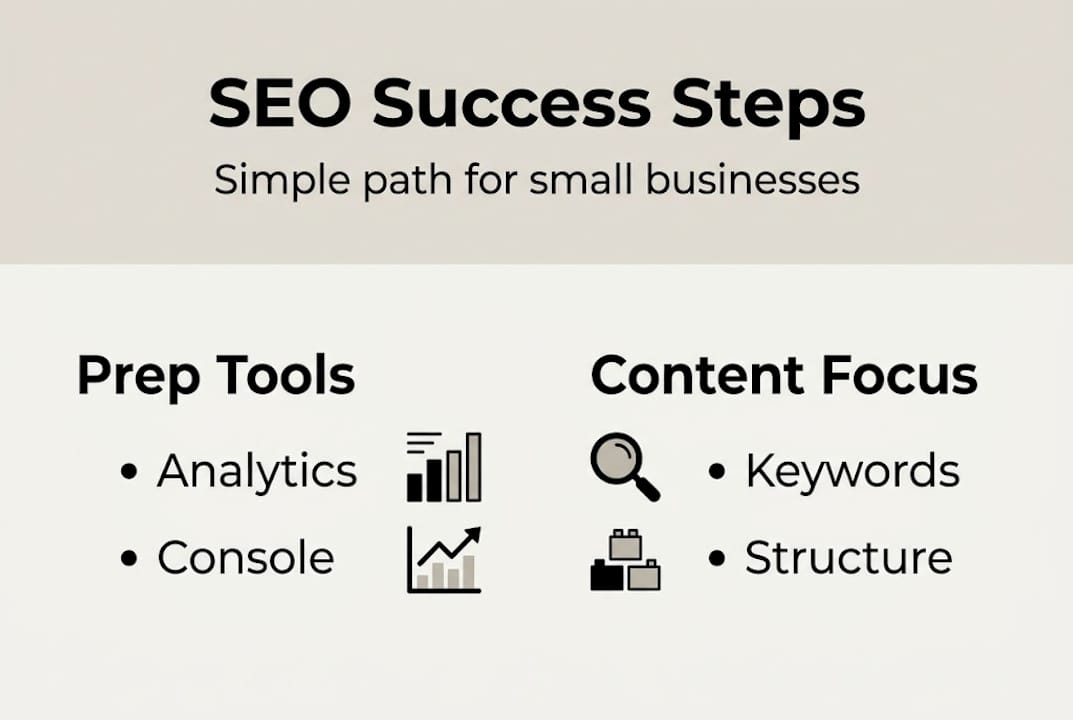
Before you optimize anything, you need a clear picture of where your site stands. Think of it like a health checkup: you can't treat a problem you haven't identified yet. Start by connecting your website to two free tools from Google — Google Search Console and Google Analytics. These platforms show you how your site performs in search, where visitors come from, and which pages attract the most attention.
As part of setting up Google Search Console, you'll also want to run a basic site audit to catch technical issues early. A good website optimization guide can help you understand what to look for. Here are the core technical elements every small business site needs:
- Mobile-friendliness: Your site must work smoothly on phones and tablets, since most searches happen on mobile devices.
- Site speed: Pages that load slowly frustrate visitors and hurt rankings. Aim for under three seconds.
- HTTPS security: A secure connection (shown by the padlock icon) is a ranking factor and builds user trust.
- XML sitemap: This file tells search engines which pages to index.
- Robots.txt file: This guides search engine crawlers on which pages to include or ignore.
- Clear navigation: Organized menus help both visitors and search engines understand your site structure.
| Tool | What it does |
|---|---|
| Google Search Console | Tracks search performance and indexing issues |
| Google Analytics | Measures traffic, behavior, and conversions |
| PageSpeed Insights | Tests your site's loading speed |
| Screaming Frog (free up to 500 URLs) | Crawls your site to find technical errors |
Reviewing these key website elements early prevents you from optimizing content on a site that has underlying structural problems.
Pro Tip: Google's free tools cover most of what a small business needs at the start. Paid tools like Semrush or Ahrefs are helpful later, but they're not necessary to get moving.
Find and target the right keywords
Once your site is prepped, the next step is to identify the terms your customers are searching for. Keyword research is the process of finding the specific words and phrases people type into search engines when looking for a product or service like yours.
For small businesses, the smartest approach is to target low-difficulty keywords — meaning terms that are relevant and specific but less competitive than broad industry terms. These niche keywords may have lower monthly search volumes, but they attract visitors who are much closer to making a decision.

| Keyword type | Search volume | Competition | Best for |
|---|---|---|---|
| High-volume (e.g., "web design") | Very high | Very high | Large brands with authority |
| Low-difficulty (e.g., "web design for florists in Austin") | Lower | Low to medium | Small, local businesses |
Here's a simple process to get started:
- List the services or products you offer and the problems they solve.
- Type those ideas into Google and note the autocomplete suggestions.
- Use Google Search Console or a free tool like Ubersuggest to check monthly search volume.
- Filter for keywords with lower competition scores (ideally under 40 on most tools).
- Check the intent: search the keyword yourself and look at the top results to confirm they match what you're offering.
Pro Tip: Visit competitor websites and use a free tool like Ubersuggest to see which keywords are driving traffic to their pages. This reveals gaps you can target with your own content.
Understanding SEO for service industries can further sharpen your approach, especially if you serve a specific local market or profession.
Optimize your content and site structure
Armed with the right keywords, you're ready to apply them and structure your site for search engines. On-page SEO refers to the changes you make directly on your web pages to help search engines understand and rank your content.
Start with these key on-page elements:
- Title tag: This is the clickable headline shown in search results. Include your target keyword near the front and keep it under 60 characters.
- Meta description: A short summary (under 160 characters) that appears below the title in search results. Make it compelling and keyword-relevant.
- Headings (H1, H2, H3): Use one H1 per page with your main keyword. Use H2s and H3s to organize subtopics naturally.
- Keyword placement: Include your target keyword in the first 100 words, in at least one heading, and naturally throughout the content.
- Internal links: Link to other relevant pages on your site to help visitors explore and to spread ranking authority.
High-quality content is the backbone of strong SEO — optimizing on-page elements only amplifies what's already well-written. Content that ranks well tends to share these qualities:
- Answers a specific question or solves a specific problem
- Is written clearly for a human audience first, search engines second
- Stays focused on a single topic per page
- Gets updated regularly to stay accurate
Important: Avoid copying content from other websites. Duplicate content confuses search engines and can hurt your rankings. Original, user-focused writing is always the right call.
A professional website structured around these principles gives you a real foundation to build on. Good site design also supports SEO by keeping visitors on your pages longer, which signals quality to Google.
Boost local SEO and build authority
For most small businesses, local SEO is where the highest-return opportunities live. Local SEO is the practice of optimizing your online presence so you show up when people search for businesses near them, such as "electrician near me" or "coffee shop in downtown Raleigh."
The single most important step in local SEO is claiming and completing your Google Business Profile. This is the listing that appears in Google Maps and the local results panel. A fully completed profile with accurate hours, photos, your service area, and a description dramatically improves your local visibility.
Beyond Google Business Profile, consistency matters. Your business name, address, and phone number should appear identically across your website, Google Business Profile, Yelp, Facebook, and every other directory where you're listed. Inconsistencies confuse search engines and can suppress your local rankings.
Building authority through backlinks is the other major lever. A backlink is a link from another website to yours. Search engines treat backlinks like votes of confidence — the more credible sites that link to you, the more trustworthy your site appears. Here are realistic ways small businesses can earn backlinks:
- Get listed in local business directories (Chamber of Commerce, BBB, industry associations)
- Ask satisfied customers or partners to link to your site
- Write a guest post for a local blog or industry publication
- Sponsor a local event and request a link on their site
- Create genuinely useful content that other sites want to reference
Quality matters far more than quantity with backlinks. One link from a well-respected local news site or industry association is worth more than twenty links from low-quality directories. Focus on relevance and credibility.
The role of SEO for service businesses goes deeper on how to build local authority in competitive markets.
Monitor, measure, and adjust your SEO efforts
SEO is not a one-time task. It requires ongoing attention to see compounding results over time. Once your initial optimizations are in place, the next step is to track what's working and what isn't.
Google Search Console is your primary tool for this. It shows you which search queries are bringing people to your site, which pages rank for which terms, and whether Google has flagged any issues. Check it at least once a month.
Google Analytics complements this by showing what happens after visitors arrive. Which pages do they spend time on? Where do they drop off? What actions do they take? These behavioral signals help you identify content that needs improvement and pages that are already performing well.
Here's a simple monthly SEO check-in routine:
- Review Google Search Console for new errors, coverage issues, or drops in impressions
- Check which pages gained or lost rankings
- Look at which queries are driving clicks and whether those pages are optimized for those terms
- Review Google Analytics for traffic trends, bounce rates, and conversions
- Update any outdated content that may be losing relevance
Pro Tip: Don't expect overnight results. SEO typically takes three to six months to show meaningful movement, and longer for newer sites. Consistent effort compounds over time.
Why sustainable SEO works better than shortcuts
You may come across services that promise fast rankings through bulk backlinks, keyword stuffing, or other tactics designed to game Google's algorithm. These "black hat" techniques might produce short-term gains, but they carry serious risks. Google actively penalizes sites that violate its guidelines, and a penalty can wipe out years of progress in a matter of days.
Sustainable SEO — often called "white hat" SEO — focuses on creating genuine value for users. It takes longer, but it builds durable rankings that don't disappear when Google updates its algorithm. For small businesses investing limited time and money, sustainable SEO is the only approach worth pursuing.
A few principles to guide your long-term approach:
- Publish content consistently, even if it's just one well-researched article per month
- Earn links naturally by creating resources people genuinely want to reference
- Fix technical issues promptly rather than letting them accumulate
- Track results and iterate, adjusting your keyword targets and content strategy based on real data
- Avoid shortcuts that promise fast results without a clear, ethical explanation of how they work
Boost your SEO with expert support
SEO is learnable, but it takes time — time that many small business owners simply don't have. Between running operations, serving customers, and managing staff, adding keyword research and content optimization to your workload is a real challenge.
At Vegas Solutions, we build websites with SEO fundamentals already in place: clean structure, fast load times, mobile optimization, and on-page elements configured correctly from day one. We also offer ongoing support that includes content updates and technical maintenance, so your site stays competitive as search algorithms evolve.
If you're ready to stop being invisible online and start attracting customers who are actively searching for what you offer, get a free website demo and see what a properly optimized small business site looks like in practice.