

TL;DR:
- SEO is accessible to small businesses with a clear framework and consistent effort.
- Technical, on-page, and off-page SEO are all crucial for improving search visibility.
- Focus on user-relevant content, local keywords, and building authority through reviews and citations.
Search engine optimization has a reputation for being complicated, expensive, and best left to tech specialists. That reputation is mostly wrong. The core principles behind SEO are logical, learnable, and within reach for any small business owner or self-employed professional who has a website. You do not need a computer science degree or a big marketing budget to start ranking better on Google. What you do need is a clear framework, the right priorities, and consistent effort. This guide breaks down the SEO fundamentals into practical, actionable steps so you can build real online visibility starting today.
Table of Contents
- What is SEO? The three pillars explained
- How to find keywords that work for your local business
- Mastering on-page SEO: Simple fixes you can do today
- Technical SEO: Making your site fast, secure, and easy for Google to read
- Off-page SEO: Building authority and trust beyond your website
- Our take: What most small business SEO guides overlook
- Next steps: Building a future-proof SEO website with Vegas Solutions
- Frequently asked questions
Key Takeaways
| Point | Details |
|---|---|
| SEO is accessible | Basic SEO methods are within reach for any small business owner looking to improve online visibility. |
| Keywords matter most | Choosing the right, realistic keywords is the foundation of SEO success for local businesses. |
| Fix technical issues early | Resolving technical SEO problems ensures your website can be indexed and ranked by search engines. |
| Authority builds trust | Getting quality backlinks and credible local citations grows your search rankings and customer trust. |
| Helpful content wins | Creating content that serves your audience's real needs is favored by search engines and customers alike. |
What is SEO? The three pillars explained
SEO stands for Search Engine Optimization. In plain terms, it is the practice of making your website easier for search engines like Google to find, understand, and recommend to people searching for what you offer. The goal is simple: show up when potential customers are looking.
According to SEO fundamentals, SEO basics consist of three core pillars: on-page SEO, technical SEO, and off-page SEO. Each one plays a distinct role, and understanding all three helps you avoid wasting effort on the wrong things. Familiarizing yourself with common website SEO terms before diving in will make the learning curve much shorter.
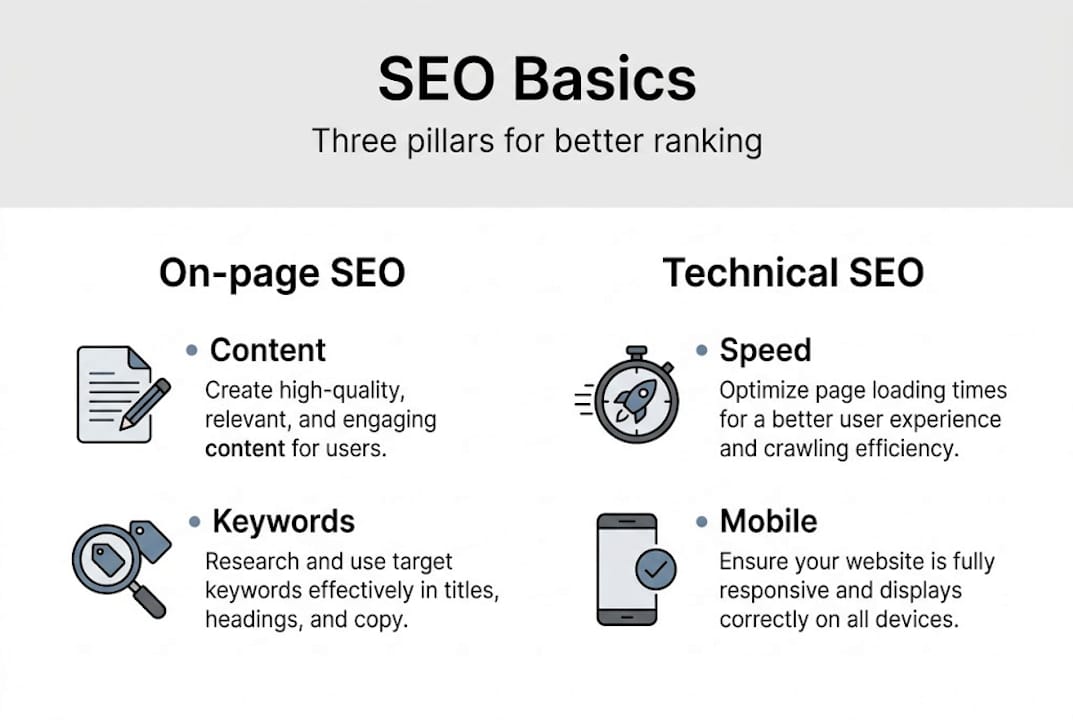
| Pillar | What it covers | Example |
|---|---|---|
| On-page SEO | Content, keywords, titles, headings | Writing a service page with the right keyword |
| Technical SEO | Site speed, security, crawlability | Adding HTTPS and submitting a sitemap |
| Off-page SEO | Backlinks, reviews, citations | Getting listed on Google Business Profile |
Here is what each pillar controls in practice. On-page SEO shapes how your content communicates relevance to search engines. Technical SEO ensures your site can actually be found and loaded without problems. Off-page SEO builds your credibility through signals that come from outside your own site.
The pillar most small business owners overlook is technical SEO. It is easy to focus on writing content and ignore whether Google can even crawl your pages properly. A technically broken site limits everything else you do.
Getting all three right delivers real benefits:
- More visibility in local and service-based search results
- Higher trust from both users and search engines
- More qualified leads arriving through organic search
- Lower long-term marketing costs compared to paid ads
- Stronger competitive position in your local market
How to find keywords that work for your local business
With a solid grasp of what SEO involves, the first real action step is identifying exactly what your audience is searching for. Keyword research is the process of finding the specific words and phrases people type into search engines when looking for services like yours.
As outlined in keyword research basics, keyword research is the foundation: identify seed keywords from your business services, use tools like Moz or Ahrefs for search volume and difficulty, and target long-tail keywords. Long-tail keywords are longer, more specific phrases that have lower search volume but also much lower competition. For a small business, they are often the smarter target.
Follow these steps to build your keyword list:
- Write down every service you offer in plain language
- Add your city, neighborhood, or region to each service
- Think about how a customer would describe their problem, not just the solution
- Enter those phrases into a free tool like Google Keyword Planner or Ahrefs' free tier
- Look for keywords with moderate monthly searches and low to medium difficulty scores
Here is an example of how this looks in practice:
| Service | Keyword example | Monthly searches | Difficulty |
|---|---|---|---|
| Plumbing | plumber near me | 90,000 | Very high |
| Plumbing | emergency plumber Austin TX | 1,200 | Low |
| Web design | small business website designer | 2,400 | Medium |
| Web design | affordable web design Las Vegas | 480 | Low |
The pattern is clear. Broad terms are dominated by large companies with massive budgets. Specific, location-based phrases are where small businesses can realistically compete and win. This is also why your website optimization guide should always begin with a focused keyword strategy rather than trying to rank for everything at once.
A common pitfall is targeting terms that are simply too competitive. If a national brand with thousands of backlinks already owns the top three spots, competing head-to-head is not a good use of your time.
Pro Tip: Build your keyword strategy around "service plus location" combinations. Phrases like "tax preparer in Denver" or "dog groomer Scottsdale" are far more likely to convert into actual customers than generic terms.
Mastering on-page SEO: Simple fixes you can do today
Now that you have the right keywords, it is time to make sure your site is ready to rank for them. On-page SEO refers to everything you control directly on your website pages, from the words you write to the technical labels attached to your images.

The on-page SEO mechanics include title tags, meta descriptions, H1s, helpful content, internal links, and image alt text. Each element sends a signal to Google about what your page is about and whether it deserves to rank.
Here is a practical checklist to work through for every key page on your site:
- Title tag: Keep it under 60 characters and include your primary keyword near the front
- Meta description: Write 150 to 160 characters that describe the page and encourage clicks
- H1 heading: Use one H1 per page that clearly states the topic and includes your keyword
- Content intent: Write for the person reading, not just for the search engine crawling
- Image alt text: Describe every image in plain language so search engines understand it
- Internal links: Link to related pages on your own site to help users and search engines navigate
Title tags that exceed 60 characters get cut off in search results, which reduces click-through rates. Keep them focused and front-load the most important information.
One of the most common mistakes is writing thin content, meaning pages with very little useful information. Google's guidelines reward pages that genuinely help users answer their questions or complete their task. A 300-word service page that says almost nothing will consistently lose to a well-written 700-word page that addresses real customer concerns.
Another frequent error is duplicate title tags across multiple pages. Every page needs a unique, descriptive title. This is especially easy to fix and pays off quickly. Staying on top of the importance of frequent updates to your content also signals to Google that your site is active and relevant.
Pro Tip: If your website runs on WordPress, a free plugin like Yoast SEO or Rank Math gives you a simple interface to edit title tags and meta descriptions without touching any code.
Technical SEO: Making your site fast, secure, and easy for Google to read
Even with perfect keyword and content strategies, your site needs a solid technical foundation to maximize those gains. Technical SEO covers everything that affects how search engines access, crawl, and index your website.
The core requirements outlined in technical SEO essentials include HTTPS security, an XML sitemap, a properly configured robots.txt file, resolved crawl errors, Core Web Vitals performance, and mobile responsiveness. These are not optional extras. They are baseline requirements for competing in search results today.
Here is what each element does for your site:
- HTTPS: Encrypts data between your site and visitors. Google flags non-HTTPS sites as insecure, which hurts both trust and rankings. Learn more about enhancing website security for your business.
- XML sitemap: A file that lists all your pages so Google can find and index them efficiently
- Robots.txt: A file that tells search engines which pages to crawl and which to skip
- Crawl errors: Broken links and missing pages that prevent Google from reading your site properly
- Mobile responsiveness: Your site must look and function well on smartphones and tablets
Core Web Vitals are a set of specific performance metrics Google uses as a direct ranking signal. They measure how fast your page loads, how quickly it becomes interactive, and how stable the layout is while loading. Poor scores here can suppress your rankings even when everything else is in order. Investing time to improve website speed is one of the highest-return technical improvements you can make.
Pro Tip: Use Google's free PageSpeed Insights tool to test your site's Core Web Vitals score and get a specific list of fixes. The Mobile-Friendly Test tool is equally useful and takes less than a minute to run.
Off-page SEO: Building authority and trust beyond your website
Once your site is technically sound, expanding your authority across the web brings additional power to your rankings. Off-page SEO refers to actions taken outside your own website that influence how search engines perceive your credibility and relevance.
For small and local businesses, the most impactful local SEO tactics include building local citations, maintaining a Google Business Profile, gathering reviews, and earning backlinks from reputable directories. These signals tell Google that real people and real organizations vouch for your business.
Key off-page activities to prioritize:
- Google Business Profile: Claim and fully complete your listing with photos, hours, and services
- Review platforms: Actively encourage satisfied customers to leave reviews on Google, Yelp, and industry-specific sites
- Local directory listings: Get listed on platforms like Yelp, Angi, and your local Chamber of Commerce website
- Quality backlinks: Earn links from local news sites, industry associations, or partner businesses
Not all backlinks are equal. A link from a trusted local news outlet or industry association carries far more weight than a link from a random, low-quality directory. Focus on relevance and authority, not just volume.
Local citations and reviews are among the strongest trust signals for service businesses. Consistent business name, address, and phone number across all listings reinforces your credibility with Google.
E-E-A-T stands for Experience, Expertise, Authoritativeness, and Trustworthiness. It is Google's framework for evaluating content quality. Adding author bios, displaying credentials, and collecting genuine reviews all contribute to stronger E-E-A-T signals. For inspiration on how strong service sites present themselves, browsing service industry website examples can be genuinely useful.
Our take: What most small business SEO guides overlook
Most SEO guides hand you a checklist and call it done. The problem is that checklists without local context often produce generic results. A plumber in Phoenix and a plumber in Portland have different competitors, different search behaviors, and different customer expectations. Copying a template rarely accounts for that.
What actually separates small businesses that win at search is a user-first mindset. As Google's own SEO priorities 2025 make clear, helpful content and E-E-A-T signals consistently outperform pages that are technically optimized but hollow in substance. Content depth and genuine usefulness beat link quantity for most local and service-based businesses.
Your real advantage is your expertise and your customer knowledge. You know the questions your clients ask before hiring you. You know the local landmarks, the seasonal patterns, the specific problems your market faces. That knowledge, turned into honest and useful content, is something no national competitor can replicate. Explore how SEO for service businesses applies these ideas in practice.
Next steps: Building a future-proof SEO website with Vegas Solutions
Understanding SEO basics is a strong start. Putting it all into practice consistently is where most small business owners run into time and resource constraints.
At Vegas Solutions, we build, host, and maintain websites specifically for small businesses and self-employed professionals. Our web management solutions handle the technical details, from site speed and security to on-page structure, so you can focus on running your business. If you want to see what a properly optimized site could look like for you, request a custom demo for $49 and receive it within three days. Check our website pricing plans to find the right fit. We handle everything from that point forward, giving you one reliable point of contact.
Frequently asked questions
How long does it take to see results from basic SEO changes?
Most small business websites start seeing ranking improvements within 2 to 3 months, though some changes can take effect sooner depending on competition and site health.
What is the easiest SEO improvement for a small business website?
Optimizing title tags and meta descriptions for your primary services is among the fastest, most impactful changes you can make without any technical expertise.
Should I focus on on-page or technical SEO first?
For most small businesses, it is best to fix technical issues that block search engines first. Unresolved technical problems limit the value of any on-page improvements you make afterward.
How important are local reviews and citations for SEO?
Local reviews and citations are major trust signals for service businesses and play a direct role in improving local search rankings and visibility.
Do I need expensive tools to get started with SEO?
No. Many effective SEO basics can be implemented using free tools. Free keyword research tools and Google Search Console provide more than enough data to get started.