

Many small business owners believe that once a website goes live, the hard work is done. This misconception costs businesses dearly. 60% of small business websites remain unchanged for over a year, resulting in 25% lower engagement rates. Regular website reviews are essential for maintaining user trust, improving search rankings, and driving sustainable business growth. This guide shows you exactly why ongoing reviews matter and how to implement them effectively.
Understanding the importance of regular website reviews
Your website is not a static brochure. It's a living business asset that directly impacts how customers perceive and interact with your brand. When visitors land on your site, they form impressions within seconds based on speed, design, and functionality.
Small businesses face rapidly evolving online consumer expectations. What worked last year may frustrate users today. Mobile browsing dominates, page speed expectations increase, and security concerns grow. Your competitors are updating their sites, which means standing still equals falling behind.
Regular assessments prevent your website from becoming outdated and losing competitiveness. The role website support plays for small businesses extends beyond basic maintenance to strategic optimization. Neglecting reviews risks declining visitor engagement and missed business opportunities.
Consider these critical impacts of regular website reviews:
- User trust: Fresh content and modern design signal your business is active and reliable
- SEO health: Search engines reward regularly updated sites with better rankings
- Security: Outdated software creates vulnerabilities that hackers exploit
- Content relevance: Market changes require messaging updates to stay competitive
- Performance: Technical issues accumulate over time and slow down your site
- Conversion optimization: Small improvements compound into significant revenue gains
Website health correlates directly with your overall digital presence and growth potential. Businesses that prioritize ongoing reviews consistently outperform those treating websites as one-time projects. The data shows small business online presence in 2026 determines competitive advantage more than ever before.
How regular reviews improve user experience and conversion rates
User experience improvements directly impact your bottom line. When visitors encounter confusing navigation, slow loading times, or broken features, they leave. That's lost revenue walking away to competitors.

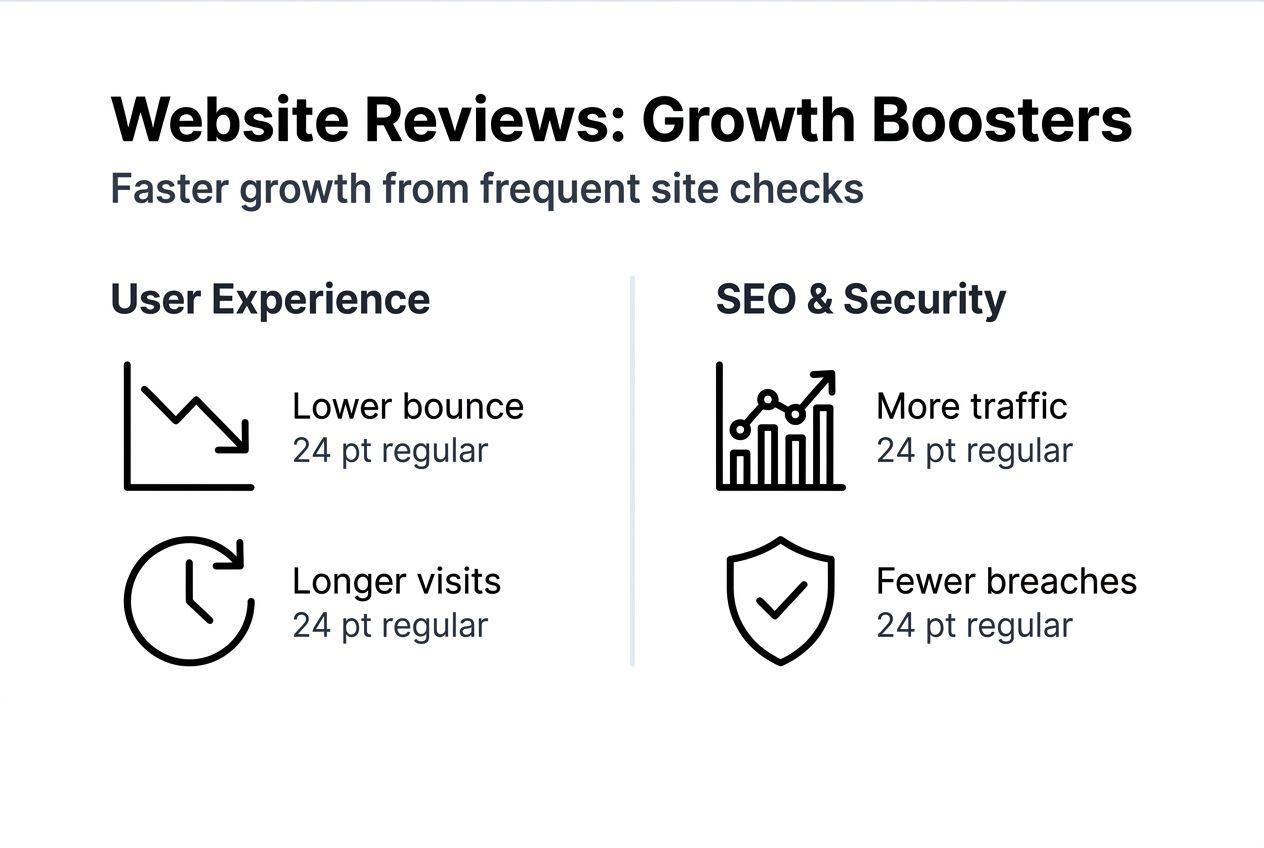
Websites that undergo periodic reviews experience 30% lower bounce rates and 20% longer sessions. These metrics translate to more opportunities for visitors to become customers. Regular reviews empower you to fix navigation issues, improve load times, enhance mobile usability, and clarify content that confuses visitors.
Customer feedback integration enables continuous usability enhancement. Pay attention to support questions, contact form submissions, and user behavior analytics. These signals reveal friction points in your customer journey.
Higher conversion rates follow naturally from better user experiences. When visitors find what they need quickly, trust your site's security, and enjoy smooth interactions, they're more likely to complete purchases or submit inquiries. Small fixes compound into significant revenue improvements.
Pro Tip: Prioritize fixes that directly address customer pain points for faster return on investment. If analytics show visitors abandoning at checkout, focus there first rather than redesigning your homepage.
Common usability issues surfaced by reviews include:
- Broken links that frustrate users and harm SEO rankings
- Slow page loads especially on mobile devices with weaker connections
- Confusing navigation that hides important information too deep in site structure
- Outdated content with old pricing, discontinued services, or expired promotions
- Poor mobile responsiveness creating awkward layouts on smartphones and tablets
- Weak calls to action that don't clearly guide visitors toward desired actions
The business website optimization guide for small businesses offers detailed strategies for addressing each of these common problems systematically.
SEO benefits of conducting routine website reviews
Search engine optimization isn't a one-time task. Google's algorithms evolve constantly, and your competitors actively work to outrank you. Routine reviews keep your SEO elements fresh and your technical health strong.
Fresh content updates signal relevance to search engines. When you regularly publish new blog posts, update service descriptions, or add customer testimonials, search engines interpret this activity as a sign your site provides current, valuable information. This improves your rankings.
Technical SEO checks form a crucial part of every review. These include fixing broken links that damage your site's authority, optimizing meta tags to improve click-through rates from search results, and enhancing site speed which is now a direct ranking factor. Ignoring these technical elements slowly erodes your search visibility.
Quarterly reviews improve organic traffic by 15 to 20% and increase customer retention by up to 18%. These numbers represent real business growth, not vanity metrics. More organic traffic means reduced advertising costs and higher quality leads.
Pro Tip: Schedule SEO audits as part of every quarterly review cycle. Create a repeating calendar event so this critical task never gets forgotten during busy periods.
Top SEO tasks to cover during each review:
- Audit and fix broken internal and external links that harm user experience and SEO
- Update title tags and meta descriptions to improve search result click-through rates
- Optimize images by compressing file sizes and adding descriptive alt text
- Refresh old content by updating statistics, expanding thin pages, and improving readability
- Check site speed using tools like Google PageSpeed Insights and implement recommendations
- Review mobile usability since most searches now happen on smartphones
- Analyze keyword performance and adjust content strategy based on what's working
| Metric | Before Regular Reviews | After Implementing Reviews |
|---|---|---|
| Organic Traffic | Baseline | +15 to 20% increase |
| Bounce Rate | Higher | 30% reduction |
| Customer Retention | Baseline | +18% improvement |
| Average Session Duration | Shorter | 20% longer |
Understanding why website updates matter helps you appreciate how seemingly small changes create compound effects on your search visibility and traffic over time.
Security and compliance aspects of website reviews
Security breaches destroy customer trust and can shut down small businesses. Regular security audits during website reviews protect both your business data and your customers' information. This isn't optional in 2026.
Common vulnerabilities include outdated plugins that hackers actively exploit, weak passwords that enable unauthorized access, and missing security patches that leave known holes unpatched. Each of these issues is preventable through systematic reviews.
Ignoring security updates creates serious risks. Data breaches expose customer information, leading to legal liability and reputation damage. Even without a breach, visitors notice outdated security indicators and leave. Small businesses neglecting updates experienced 30% higher customer churn due to perceived unreliability.
Regular compliance checks help you avoid legal penalties and improve credibility. Depending on your industry and location, you may need to comply with data protection regulations, accessibility standards, or specific professional requirements. Reviews ensure you stay compliant as regulations evolve.
"Small businesses neglecting updates experienced a 30% higher likelihood of customer churn due to perceived unreliability and outdated interfaces."
Essential security review tasks for small business websites:
- Update all software including content management systems, plugins, and themes
- Review user access permissions and remove accounts for former employees or contractors
- Check SSL certificate status to ensure secure connections remain valid
- Scan for malware using security plugins or professional scanning services
- Test backup systems to confirm you can recover if something goes wrong
- Review form security to prevent spam and protect sensitive information submission
- Monitor for unauthorized changes that could indicate a compromised site
The website security guide for small businesses provides detailed implementation steps for each security task.
Pro Tip: Use managed services to handle technical security updates if you lack in-house expertise. The cost of professional security management is far less than recovering from a breach.
Framework and best practices for effective website reviews
A structured approach makes website reviews manageable and effective. The Continuous Website Review Cycle provides a framework that fits small business realities.
This cycle consists of four phases: Assessment where you evaluate current performance, Prioritization where you rank issues by business impact, Implementation where you make necessary changes, and Monitoring where you track results and identify new opportunities. This cycle repeats quarterly for most small businesses.
Recommended review frequency is quarterly, balancing resource constraints with maintaining website freshness. Some elements require more frequent attention, like security patches which should be applied immediately. Others, like major content refreshes, can happen less often. Quarterly reviews catch most issues before they become serious problems.
| Approach | Pros | Cons |
|---|---|---|
| DIY Reviews | Lower immediate cost, complete control, builds internal knowledge | Time-consuming, requires technical skills, easy to miss critical issues |
| Professional Managed Reviews | Expert execution, comprehensive coverage, time savings, proactive problem detection | Higher cost, less direct control, requires vendor relationship management |
Pro Tip: Focus first on high-impact fixes aligned with your business goals. If you need more leads, prioritize conversion optimization. If brand awareness is the goal, focus on content and SEO.
Critical checklist items for every review:
- Usability testing including navigation, forms, and mobile experience
- SEO audit covering technical issues, content freshness, and keyword performance
- Security scan for vulnerabilities, outdated software, and compliance issues
- Content review to update outdated information and identify gaps
- Performance testing for page speed, broken links, and functionality
- Analytics analysis to understand user behavior and identify opportunities
- Backup verification to ensure disaster recovery capability
Prerequisites for effective reviews include access to your website analytics platform to understand visitor behavior, clearly defined business goals that guide prioritization decisions, and either technical skills or a trusted partner to implement fixes. Without these prerequisites, reviews become inefficient guesswork.
Common failure points and prevention strategies:
- Neglect: Set calendar reminders and treat reviews as non-negotiable business maintenance
- Overwhelm: Start small with high-impact items rather than attempting everything at once
- Technical barriers: Partner with experts when tasks exceed your skill level
- Lack of metrics: Establish baseline measurements before changes to track improvement
The business website optimization guide helps you implement these best practices systematically. Understanding why updating your website benefits your business creates motivation to maintain consistency. Familiarizing yourself with website terms small business owners should know in 2026 improves communication with technical partners.
Remember that website upkeep importance extends beyond avoiding problems. It's about proactively creating competitive advantages through continuous improvement.
How Vegas Solutions supports ongoing website reviews
Managing regular website reviews takes time and technical knowledge that many small business owners don't have. That's exactly why Vegas Solutions exists.
We handle your website completely so you can focus on running your business. Our managed review process includes systematic SEO optimization, security updates, performance monitoring, and usability improvements. You get expert attention without learning complex technical skills or carving out hours from your schedule.
Our approach fits the Continuous Website Review Cycle naturally. We assess your site quarterly, prioritize fixes based on your business goals, implement changes professionally, and monitor results continuously. One point of contact, simple language, and fast turnaround mean no tech headaches.
You can start with a $69 demo to experience hands-off website health management. Only continue if it feels like a good fit. Our flexible pricing plans accommodate various small business budgets and needs.
Pro Tip: Outsourcing website reviews reduces tech headaches and lets you focus on growing your business. The time you save and problems you avoid typically exceed the service cost.